
What if the strongest case for recovery coaching starts with your everyday goals, not just a diagnosis? If you’re wondering how to get NDIS funding for recovery coach Victoria, it helps to separate meeting NDIS access requirements from getting a particular support funded. Your plan needs to show how the support relates to your disability support needs and goals.
It’s understandable to feel unsure about what to say in a planning conversation, what evidence to bring or where recovery coaching fits in your budget. Psychosocial recovery coaching is funded under the Capacity Building support category, but inclusion and funding depend on your individual plan and circumstances. Your plan-management type also affects how providers are engaged and payments are handled.
This guide explains how to describe your support needs, connect them to practical NDIS goals and prepare relevant evidence for a planning or review conversation. You’ll also learn what steps to take next and how recovery coaching can support participants across Victoria, including Melbourne, Ballarat, Geelong and Bendigo. A clear, person-centred explanation can help you advocate for support that fits your recovery journey.
Key Takeaways
- NDIS access and funding for a particular support are separate decisions. Recovery coaching is capacity-building support, not clinical treatment.
- To understand how to get NDIS funding for recovery coach Victoria, connect your request to your goals and the functional impacts of your disability.
- Whether you’re preparing for initial planning or a later plan review, clear examples of your support needs can help explain why coaching may be relevant.
- NDIA-managed, plan-managed and self-managed plans have different provider and payment arrangements, so understand how your plan is managed.
- Once support is funded, work with your recovery coach to agree on goals, communication preferences and ways to review progress.
NDIS access and recovery coach funding in Victoria: what is the difference?
The pathway has two distinct parts. First, a person must meet the NDIS access requirements. Separately, the National Disability Insurance Agency (NDIA) considers which supports to include in an individual plan. NDIS access doesn’t automatically mean a recovery coach will be funded. The request needs to relate to the person’s disability support needs and goals, and the NDIA makes decisions based on individual circumstances and current rules.
Psychosocial recovery coaching is capacity-building support. A recovery coach works with a participant to build skills, pursue their own recovery goals and connect with relevant services. It isn’t clinical treatment. For a broader background on the scheme, see this National Disability Insurance Scheme (NDIS) overview.
Who may be eligible for NDIS support related to psychosocial disability?
A mental health diagnosis alone doesn’t establish NDIS access eligibility. The NDIA considers how a person’s disability affects everyday functioning, including whether those impacts are lasting and how they affect daily life. When exploring how to get NDIS funding for recovery coach Victoria, keep the questions separate: does the person meet NDIS access requirements, and could recovery coaching address support needs and goals in their plan? For a closer look at access requirements, read NDIS Eligibility Explained: Complete 2026 Guide to Access Requirements.
What does a psychosocial recovery coach help with?
A recovery coach works alongside the participant, not in their place. Together, they can identify participant-led recovery goals and build practical skills for daily life. This could mean breaking a personal goal into manageable steps, strengthening confidence to manage routines or finding ways to connect with community resources.
Coaching can also help a participant connect with relevant NDIS and mainstream services. It complements clinical treatment rather than replacing it: a recovery coach can support progress towards everyday goals, while clinical care addresses treatment needs. The support focuses on the participant’s priorities and is shaped around their circumstances and preferences.
In Victoria, local knowledge can help make community connections relevant, whether a participant lives in Melbourne, Ballarat, Geelong, Bendigo or a surrounding area. When describing the request, explain the everyday need and the personal goal the support could help address. This gives the NDIA a clearer picture to consider, without guaranteeing a particular funding decision.
How to request NDIS funding for a recovery coach: the steps
Build your request around the support you need in everyday life and the goals you want to work towards. There are two main opportunities to raise recovery coaching: during initial NDIS planning, or later if you already have a plan. Start by identifying where you are in the process, then describe the connection between your needs, goals and the support requested.
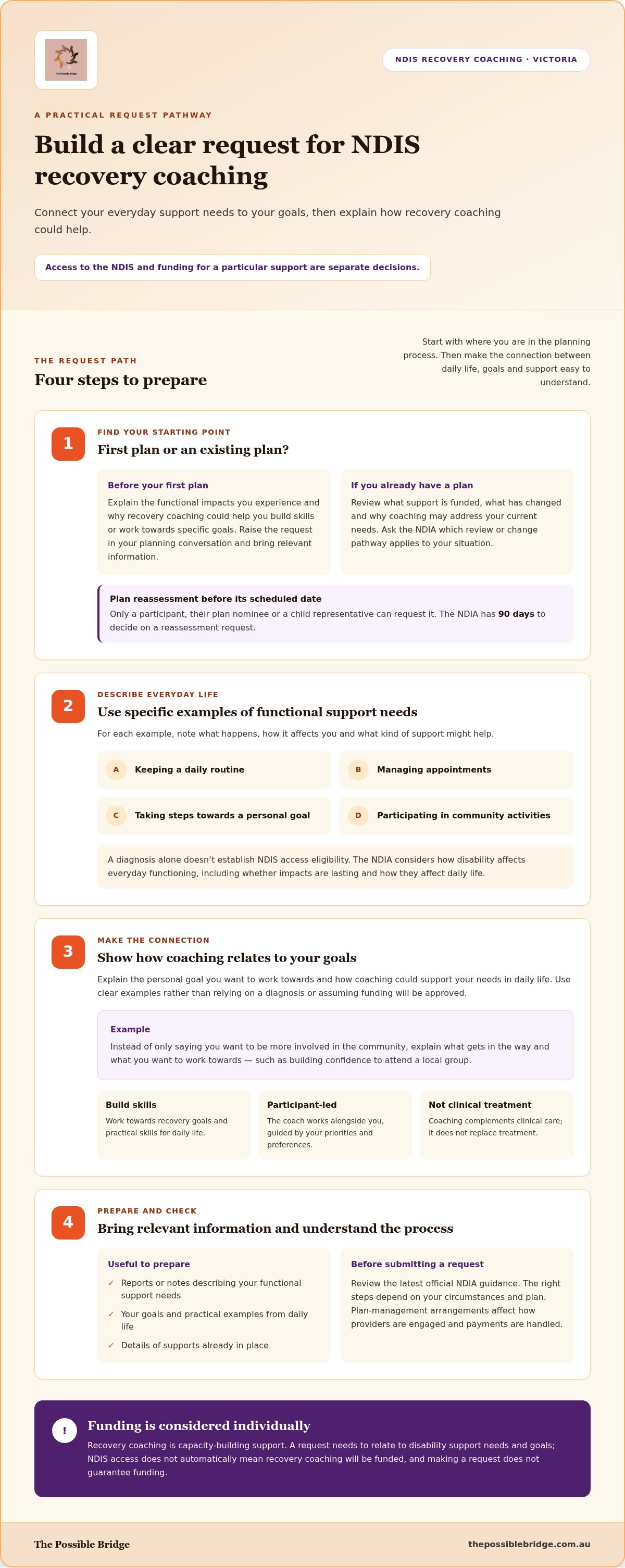
- 1. Before your first plan: Explain the functional impacts you experience and why recovery coaching could help you build skills or work towards specific goals. Raise the request during your planning conversation and bring relevant supporting information.
- 2. If you already have a plan: Review the plan and note what support is funded, what has changed and why you believe recovery coaching may address your current needs. Ask the NDIA about the appropriate review or change pathway. As at October 2026, only a participant, their plan nominee or a child representative can request a plan reassessment before its scheduled date. The NDIA has 90 days to decide on a reassessment request.
- 3. Explain the connection: Describe how coaching relates to your goals and functional needs. Use clear examples rather than relying on a diagnosis or assuming funding will be approved.
- 4. Understand the process: Review the latest official NDIA guidance before submitting a request, as the right steps depend on your circumstances and plan. The NDIA’s NDIS plan management options explain how different management arrangements affect the use of plan funding.
Preparing for an NDIS planning or plan review conversation
Write down practical examples of what you’d like support with. This could include difficulty keeping a daily routine, managing appointments, taking steps towards a personal goal or participating in community activities. For each example, note what happens, how it affects you and what kind of support might help. Bring relevant reports or notes that describe your functional support needs, along with your goals and details of supports already in place.
For example, instead of saying only that you want to be more involved in the community, explain what gets in the way and what you want to work towards, such as building confidence to attend a local group. A specific example makes it easier to understand how coaching relates to your daily life.
What if recovery coaching is not shown in the current plan?
Ask the NDIA which review or change process applies to your situation. Explain what has changed, the support you’re seeking and how it relates to your goals and daily functioning. The NDIA considers requests individually under current rules, so a request doesn’t guarantee that funding will be added.
If you’re preparing to discuss goal-focused support, explore psychosocial recovery coaching with The Possible Bridge. For anyone asking how to get NDIS funding for recovery coach Victoria, a clear account of everyday needs, goals and requested support can make the conversation more focused.
NDIS funding for recovery coaching: compare plan management options
Your plan-management type affects how funding is handled and which providers you can engage, but it doesn’t decide whether recovery coaching is included in your plan. The NDIA makes funding decisions based on your individual support needs, goals and plan circumstances. If you’re exploring how to get NDIS funding for recovery coach Victoria, separate these two questions: is the support funded in your plan, and how can you use that funding?
| Plan management type | How funding is managed | Provider access |
|---|---|---|
| NDIA-managed | The NDIA manages payments to providers. | Provider access is generally limited to NDIS-registered providers. Check current NDIA requirements for your circumstances. |
| Plan-managed | A plan manager handles invoices and payments on your behalf. | There may be greater flexibility in provider choice. Confirm current registration rules and any applicable restrictions with the NDIA. |
| Self-managed | You manage payments and keep records of spending. | There may be greater flexibility in provider choice, subject to current NDIS rules and the supports in your plan. |
These are general distinctions, not a guarantee that a particular service can be funded from your plan. Rules can change, so use the NDIA’s guide to NDIS plan management options and current guidance to understand what applies. Managing funds is different from deciding which supports are funded: a plan manager can process payments, but doesn’t approve new supports or change your plan.
How plan management can affect provider choice
Before arranging a service, make sure the support is included in your plan, the available funding can be used for it, and the provider’s registration status suits your management type. NDIA registration requirements can differ across management options, so use current rules rather than relying on older advice. Support-item names, funding categories and price limits can also change. The 2026-27 NDIS Pricing Schedule took effect on 1 July 2026; refer to the current schedule for relevant details.
Recovery coach or support coordinator: which support fits?
Both roles can help participants work towards goals, but their focus differs. Support coordination centres on understanding a plan, organising supports and connecting with providers. Psychosocial recovery coaching focuses on a participant’s psychosocial recovery journey, building capacity and skills, and connecting with community resources. The right fit depends on the person’s needs and goals. The NDIA generally funds one role or the other, rather than both, so explain why the requested support is appropriate to your circumstances.
What to prepare for an NDIS recovery coach funding request in Victoria
Preparation can help you explain what support you’re seeking and how it relates to your life. For a conversation about how to get NDIS funding for recovery coach Victoria, focus on practical examples, personal goals and the role you’d like coaching to play. Describe your circumstances clearly, without making claims about likely approval.
A clear support request connects your everyday needs and goals with the practical role recovery coaching could play.
Evidence and examples that help explain support needs
Use this checklist to organise your thoughts before a planning or review conversation:
- Goals: Note what you want to work towards, such as building a steadier routine or taking part in a local activity.
- Functional impacts: Record brief examples of barriers affecting daily routines, relationships, appointments or community access. Include what support helps and where difficulties remain.
- Current supports: List the formal and informal support you already receive, and explain any gaps or changes in your needs.
- Relevant information: Bring reports or notes from relevant professionals if they describe how your disability affects everyday functioning and what support may help.
- Questions: Write down what you want to understand about the requested support, your plan and the next steps in the process.
Specific examples are clearer than broad statements. For instance, describe how a change in routine affects your ability to attend appointments rather than making an unsupported claim about what a diagnosis means for you. Professional reports can add context, but no single document guarantees funding approval. The NDIA considers each request in light of individual needs, goals and current rules.
Local support pathways across Melbourne and regional Victoria
Recovery goals may involve connecting with community resources close to home. A participant in Melbourne might want to build confidence attending a local group, while someone in Ballarat, Geelong or Bendigo may have different activities and services in mind. The Possible Bridge provides psychosocial recovery coaching across these Victorian areas, supporting participants to work towards their own goals, build skills and connect with community resources.
Keep NDIS planning separate from urgent mental health or crisis support. A funding request is a planning process, not an immediate response to a crisis. If you need urgent help, use appropriate emergency or crisis support services.
To explore participant-led recovery coaching and prepare to discuss your goals, connect with The Possible Bridge about recovery coaching.
After funding: start recovery coaching with a clear plan
Once recovery coaching is included in your plan, shape the support around what matters to you. Funding provides a pathway, but a useful working relationship starts with shared expectations, practical goals and regular conversations about what’s helping.
Agreeing on recovery goals and ways of working
Begin with your priorities and strengths. You might want to build confidence with daily routines, take steps towards employment or feel more connected to your local community. Agree with your recovery coach on the first goals to focus on, a manageable pace and how you prefer to communicate.
It can also help to decide how you’ll review progress. Talk about what’s working, what feels difficult and whether the next steps still fit your circumstances. Goals aren’t fixed; you can revisit them as your needs and priorities evolve. You remain in control of decisions, choices and next steps, with coaching shaped around your direction.
Before support begins, make sure you understand what recovery coaching is funded in your plan and how the funding can be used. A recovery coach works with you on capacity building, personal recovery goals and community connections. This is distinct from managing plan funds or providing clinical psychology, which are different functions.
Taking the next step with The Possible Bridge
The Possible Bridge provides psychosocial recovery coaching across Melbourne, Ballarat, Geelong, Bendigo and surrounding Victorian areas. Support is collaborative and focused on helping you build skills, move towards your goals and connect with community resources that are relevant to you.
If you’re still working through how to get NDIS funding for recovery coach Victoria, remember that funding decisions are individual. Once support is in place, a clear plan for working together can help turn funded hours into purposeful steps that reflect your goals and preferences.
When you’re ready, explore psychosocial recovery coaching with The Possible Bridge and consider what you’d like your next steps to look like.
Take your next step towards recovery-focused support
Understanding how to get NDIS funding for recovery coach Victoria starts with separating NDIS access from funding for a specific support. If you’re preparing a request, connect your everyday support needs with clear goals and practical examples. Your plan-management type affects how funding is handled, while the NDIA considers support requests individually.
Once recovery coaching is in place, agree on priorities, communication preferences and ways to review progress. The Possible Bridge provides psychosocial recovery coaching across Melbourne, Ballarat, Geelong, Bendigo and surrounding Victorian areas, with support focused on building skills, pursuing personal goals and connecting with community resources.
If you’re ready to explore a participant-led approach, explore recovery coaching with The Possible Bridge. Take the next step by discussing the goals and priorities you’d like your recovery coaching to support.
Frequently Asked Questions
Can I get NDIS funding for a recovery coach in Victoria?
Yes, recovery coaching may be included in an NDIS plan if the NDIA considers it appropriate for your individual support needs and goals under current rules. NDIS access eligibility and funding for this specific support are separate decisions. If you’re researching how to get NDIS funding for recovery coach Victoria, explain how coaching could help with your functional needs and capacity-building goals. A request doesn’t guarantee funding, so use current NDIA guidance.
Is a diagnosis enough to get NDIS funding for psychosocial recovery coaching?
No, a diagnosis alone doesn’t establish NDIS access or ensure recovery coaching will be funded. For access, the NDIA considers whether a person meets its eligibility requirements, including the lasting functional impacts of their disability. Funding for coaching is a separate decision based on individual needs, goals and plan circumstances. Relevant reports may help describe everyday impacts, but no single document guarantees access or funding.
How do I ask the NDIA for recovery coaching in my plan?
Raise the request during initial planning or, if you already have a plan, ask about the relevant review or change process. Prepare specific examples of how your disability affects everyday activities, the goals you want to pursue and how recovery coaching could help. Bring relevant reports or notes about your functional support needs. Explain the connection clearly, then use current NDIA guidance for the steps that apply to your circumstances.
What happens if my NDIS plan does not include a recovery coach?
If recovery coaching isn’t included, ask the NDIA which review or plan-change pathway applies to your situation. Explain what has changed, the support you’re requesting and how it relates to your functional needs and goals. The available process may depend on your plan and circumstances, so use current NDIA guidance before making a request. The NDIA considers requests individually, and asking for a change doesn’t guarantee funding will be added.
Can I use a recovery coach with a plan-managed or self-managed NDIS plan?
It may be possible, depending on your plan, the support funding available and current provider rules. Plan-managed and self-managed participants generally have more provider choice, while NDIA-managed funding usually requires registered providers. These arrangements don’t determine whether recovery coaching is funded in your plan. Before engaging a provider, understand the current NDIA requirements for your management type and make sure the support aligns with your plan.
What is the difference between a recovery coach and a support coordinator?
A support coordinator helps you understand your plan, organise supports and connect with providers. A psychosocial recovery coach focuses on your recovery goals, building capacity and skills, and connecting with relevant community resources. The roles have different purposes, so they aren’t automatically interchangeable. The right fit depends on your needs, goals and plan. The NDIA generally funds one role or the other, rather than both, depending on individual circumstances.
Can I access psychosocial recovery coaching in Ballarat, Bendigo, Geelong or Melbourne?
Yes. The Possible Bridge provides psychosocial recovery coaching in Melbourne, Ballarat, Geelong, Bendigo and surrounding Victorian areas. Support is collaborative and centred on your goals, skills and community connections. Coaching can help you work towards everyday priorities and connect with relevant local resources. Whether you’re in a metropolitan or regional area, your support plan should reflect your individual needs and preferences.


