

A formal medical diagnosis alone will not unlock funding. Understanding ndis eligibility in 2026 centres on one fundamental reality: access hinges on your functional capacity in everyday life, not diagnostic labels alone. If you feel overwhelmed by administrative paperwork, uncertain about which treating professionals to consult, or anxious that wording mistakes could trigger a swift rejection, your frustration is completely valid. Proving permanent and significant impairment across learning, self-care, or social interactions can often feel needlessly complex, especially for episodic and psychosocial conditions.
You don't have to chart this course in the dark. This guide gives you the practical clarity needed to master the core age, residency, and disability criteria, gather robust allied health evidence, and prepare your application with steady confidence. From gathering functional assessments to submitting your access request, here is your step-by-step roadmap to opening the door to approved supports.
Key Takeaways
- Understand how age, residency, and permanent impairment criteria establish your baseline ndis eligibility before you lodge any paperwork.
- Discover why demonstrating substantial functional impact across just one of the six core life domains carries more weight than a diagnostic label alone.
- Learn which allied health reports and medical specialists provide the precise functional evidence NDIA delegates look for to prevent application delays.
- Map out the straightforward pathway from submitting your Access Request Form to holding your first planning meeting and activating your approved supports.
What Is NDIS Eligibility? The Three Core Gateway Requirements
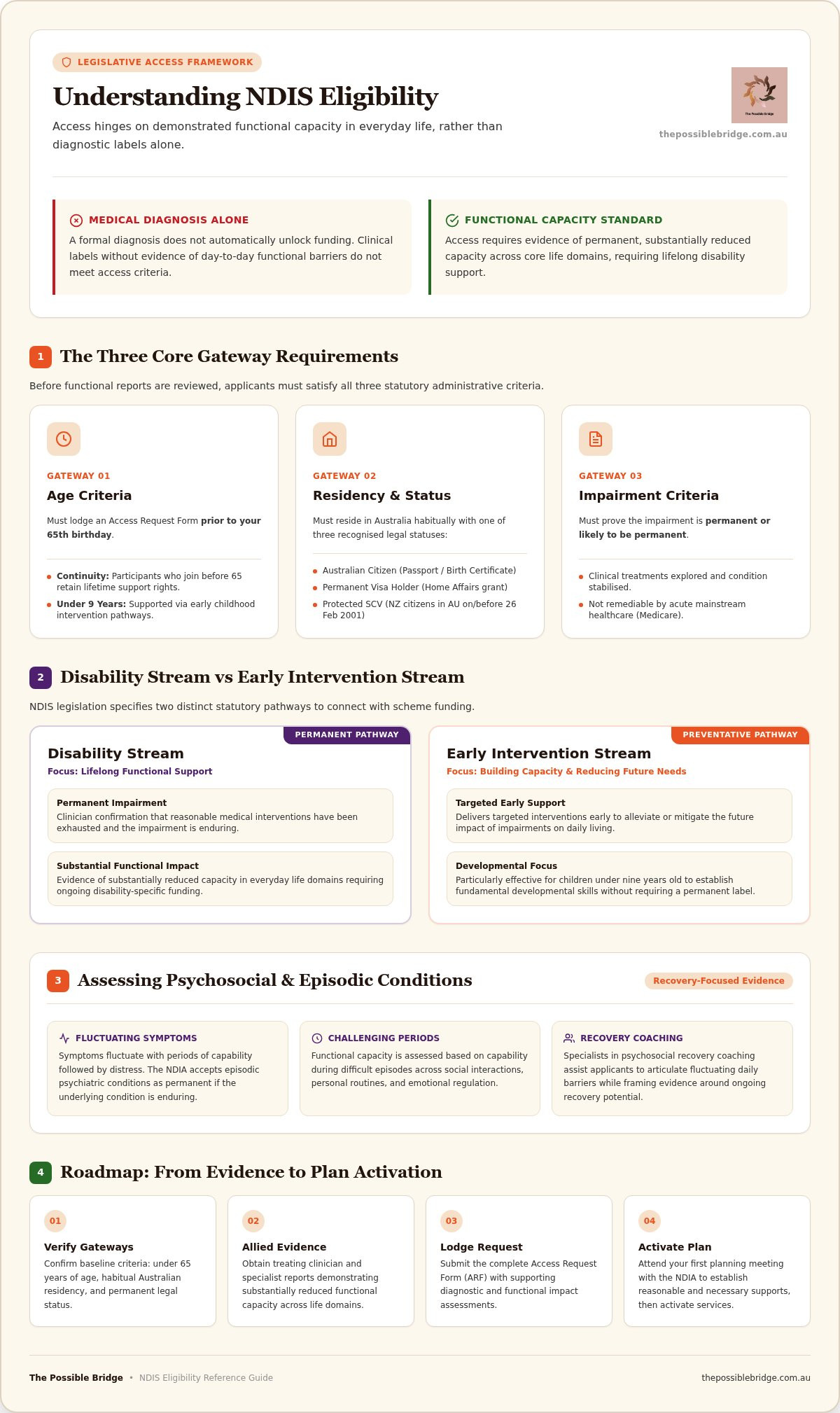
Securing support begins with understanding that ndis eligibility is not an arbitrary administrative hurdle. Governed by federal legislation, it functions as an objective, evidence-based assessment designed to connect people with sustainable resources. Rather than evaluating conditions in isolation, the statutory framework looks at identity, location, and functional capacity. Before delegates review medical assessments or functional reports, every applicant must first clear three mandatory administrative gateways: age, residency, and impairment criteria. As established by the National Disability Insurance Scheme (NDIS), clearing these initial benchmarks confirms your legal right to access government-funded disability supports.
Age Criteria: Applying Before the 65-Year Threshold
You must lodge your Access Request Form before your 65th birthday. This cut-off marks the clear legislative boundary separating disability support from My Aged Care. If you acquire a disability after turning 65, the aged care system will support you instead.
Importantly, participants who join before turning 65 retain full continuity of support. You are not forced out of the scheme on your 65th birthday; you retain the legal right to stay with the NDIS or transition into aged care when the time feels right. For families with children under nine years old, early childhood pathways provide early intervention supports without always requiring a confirmed permanent diagnosis, establishing developmental skills when they matter most.
Residency and Citizenship Requirements Explained
Establishing ndis eligibility requires proof of deep, ongoing ties to the Australian community. To pass this gateway, you must reside in Australia habitually and hold one of three recognised legal statuses:
- Australian citizenship: Confirmed via an Australian birth certificate, passport, or citizenship certificate.
- Permanent visa holder: Confirmed through permanent residency documentation granted by the Department of Home Affairs.
- Protected Special Category Visa: Typically applicable to New Zealand citizens who resided in Australia on or before 26 February 2001.
Proving habitual residence requires demonstrating that Australia is your permanent home. The National Disability Insurance Agency (NDIA) verifies this through utility bills, residential lease agreements, Australian bank accounts, and employment records. Meeting these residency standards ensures you build your support network on a secure, recognised foundation.
Understanding the Disability and Early Intervention Requirements
NDIS legislation outlines two distinct doorways to scheme access: the disability stream and the early intervention stream. Meeting ndis eligibility under either pathway requires proving that your condition is not temporary or remediable by the mainstream healthcare system. While Medicare addresses clinical treatments, surgeries, and acute hospital care, the scheme funds reasonable and necessary supports that build functional independence in everyday life.
The Disability Stream: Permanency and Functional Impact
Qualifying through the disability stream requires proving that your impairment is permanent or likely to be permanent. Under National Disability Insurance Agency (NDIA) guidelines, treating clinicians must confirm that all available, reasonable treatment options have been explored and the condition has stabilised. The impairment must result in substantially reduced functional capacity, creating a clear, lifelong requirement for disability-specific support rather than short-term clinical intervention.
Assessing Psychosocial Disability and Episodic Conditions
Psychosocial disability often creates anxiety for applicants because mental health symptoms naturally fluctuate over time. You might experience periods of balance and capability, followed by times of significant distress. The NDIA accepts episodic psychiatric conditions as permanent if the underlying condition is enduring. Assessing functional impact focuses on your capacity during challenging periods across social interactions, personal routines, and emotional regulation. Framing your evidence in recovery-focused language highlights your potential for progress while realistically describing daily barriers. For those charting this pathway, working alongside specialists in psychosocial recovery coaching can help pinpoint how fluctuating barriers affect daily living.
The Early Intervention Stream: Reducing Future Support Needs
The early intervention stream approaches support from a preventative angle. Instead of demonstrating a permanent, lifelong deficit, you show that targeted intervention now will alleviate or stabilise your support requirements in the future. This pathway focuses on preserving functional independence, preventing chronic deterioration, and building foundational capacity. You can consult official guidance on how to apply for the NDIS to review specific documentation benchmarks for early intervention candidates across sensory, physical, and cognitive conditions.
The Six Core Life Domains: How the NDIA Assesses Functional Capacity
A diagnostic label confirms what condition you have; functional capacity reveals how it shapes your daily reality. When measuring ndis eligibility, assessors do not judge your circumstances solely on medical charts or pathology scans. Instead, they examine whether an impairment results in substantially reduced functional capacity across six statutory domains. You do not need to experience severe disruption across all six areas. Demonstrating that you require ongoing personal assistance, home modifications, or assistive technology to complete tasks within just one domain can satisfy the core NDIS eligibility requirements.
Communication, Social Interaction, and Learning
This group of domains captures how you connect with others and process the world around you:
- Communication: Covers receptive and expressive language. It measures whether you can express needs, understand spoken instructions, or require non-verbal tools and communication devices to be understood.
- Social interaction: Examines interpersonal connection, emotional regulation, and making or sustaining relationships. Reports should detail whether sensory overload, anxiety, or cognitive barriers require behavioural prompts or support to engage with your community safely.
- Learning: Evaluates how you absorb, retain, and apply new knowledge or life skills, such as remembering daily safety steps, cooking basic meals, or understanding transport routines.
Mobility, Self-Care, and Self-Management
These domains reflect your physical independence, personal wellbeing, and day-to-day autonomy:
- Mobility: Measures your ability to move safely around your home and get out into your local neighbourhood, including your reliance on transfer equipment, wheelchairs, or physical guidance.
- Self-care: Encompasses essential bodily tasks. This includes showering, dressing, toileting, preparing meals, and eating independently without regular hands-on assistance or verbal prompting.
- Self-management: Focuses on cognitive organisation, executive functioning, and decision-making. It looks at your ability to manage household finances, organise appointments, and maintain personal safety without structured oversight.
How to Gather Evidence and Complete the NDIS Access Request
Transforming your daily experience into an approved application requires a methodical, step-by-step approach. Successfully demonstrating ndis eligibility relies on presenting objective, consistent proof that directly connects your diagnosis to everyday functional barriers. By methodically assembling your documentation, you minimise administrative friction and give NDIA decision-makers an unmistakable picture of your support requirements.
Selecting the Right Medical and Allied Health Professionals
Your General Practitioner provides the clinical foundation by verifying diagnosis, treatment history, and permanency. However, functional evidence carries equal weight. An Occupational Therapist’s Functional Capacity Assessment (FCA) offers gold-standard proof across personal care, domestic tasks, and mobility. Similarly, comprehensive reports from psychologists, psychiatrists, or speech pathologists articulate cognitive, emotional, and communication challenges that standard medical certificates often miss.
Step-by-Step Evidence Gathering and Form Lodgement
Gathering your documentation follows a structured, four-stage pathway:
- Step 1: Obtain the paperwork: Download the official Access Request Form (ARF) online or request a copy directly from the NDIA by calling 1800 800 110.
- Step 2: Complete Part A: Fill in your personal details, proof of residency, identity documentation, and preferred communication methods.
- Step 3: Coordinate Part B: Ask your primary treating clinicians and allied health specialists to complete the functional impact sections, confirming permanency.
- Step 4: Cross-check and lodge: Review all reports against the six core life domains before lodging. Under the NDIA Participant Service Guarantee, delegates aim to make an access decision within 21 days of receiving a completed file.
Avoiding Common Pitfalls in Access Documentation
Administrative wording errors cause unnecessary application delays. Eliminate ambiguous statements that suggest medical treatments remain uncompleted or exploratory, as assessors may interpret this as an unresolved condition. To establish ndis eligibility with confidence, ensure documentation describes your baseline capacity without informal support, rather than what you can achieve on your best days. When managing regional allied health appointments across Geelong, Ballarat, or Bendigo, local insight keeps your pathway clear. Learn how The Possible Bridge supports community navigation, and reach out today to connect with local support coordination once your funding is confirmed.
After Eligibility Approval: Activating Your NDIS Plan in Victoria
Receiving your access confirmation letter marks a major milestone. Confirmation of your ndis eligibility means the gateway has officially opened, transitioning your journey from proving functional impact to building purposeful daily momentum. Soon after access approval, an NDIA planner or Local Area Coordinator (LAC) contacts you to organise your initial planning conversation. This collaborative discussion determines how your approved funding translates into tangible, everyday supports.
Preparing for Your First Planning Meeting
Approaching your planning meeting with defined priorities ensures your funding aligns directly with your lifestyle. Frame your conversation around clear, practical objectives:
- Define personal goals: Formulate specific short-term and long-term goals centred on daily independence, community engagement, and employment opportunities.
- Map your current network: Clearly identify what family and informal networks assist with, drawing a firm line where professional, funded support is vital.
- Advocate for coordination: Request funded Support Coordination or Psychosocial Recovery Coaching within your capacity-building budget to help you navigate and coordinate service agreements effectively.
Local Provider Selection Across Melbourne and Regional Victoria
Activating an approved plan requires trusted local connections. Establishing reliable supports across Melbourne, Ballarat, Geelong, and Bendigo is simpler when you collaborate with providers embedded in regional communities. Rather than managing complex contracts alone, a dedicated support coordinator guides provider selection, resolves operational roadblocks, and ensures your funding delivers genuine value.
For participants experiencing mental health challenges, working alongside a recovery coach offers steady, structured guidance to maintain motivation, build resilience, and navigate community life. You can access purpose-driven guidance through The Possible Bridge today, ensuring your newly confirmed funding builds a clear pathway toward lasting independence.
Transforming Your Access into Everyday Independence
Clarifying your ndis eligibility is fundamentally about communicating functional reality rather than collecting medical labels. When you focus on everyday impact across the core life domains and assemble comprehensive allied health evidence, the application process shifts from overwhelming administrative paperwork into a clear, structured pathway. Once access is granted, your focus naturally turns to converting funded supports into purposeful daily momentum.
You don't have to navigate the next steps alone. As an NDIS-registered provider with deep roots across Melbourne, Ballarat, Geelong, and Bendigo, The Possible Bridge specialises in Support Coordination, Psychosocial Recovery Coaching, and building employment readiness. We take a person-centred approach designed to strengthen individual autonomy, resolve provider roadblocks, and connect you with trusted local resources. Connect with The Possible Bridge today to turn your approved plan into lasting progress.
Frequently Asked Questions
Is there an age limit to qualify for NDIS eligibility?
Yes, you must submit your completed Access Request Form before your 65th birthday. If you are 65 or older, you must access support through My Aged Care instead. Existing participants who turn 65 while funded retain the legal right to continue receiving supports through the scheme. For young children under nine years old, early intervention pathways exist without requiring a permanent disability diagnosis.
Can I apply for the NDIS if my medical condition fluctuates?
Yes, fluctuating and episodic conditions qualify if the underlying impairment is considered permanent. The NDIA recognises that conditions such as psychosocial disabilities or multiple sclerosis vary in intensity over time. When preparing your evidence, describe your functional capacity during your most challenging periods rather than your best days. Treating professionals should detail baseline restrictions affecting self-care, social interaction, and community participation.
How much medical evidence do I need to submit with my Access Request?
You need enough objective documentation to confirm your diagnosis, verify permanency, and demonstrate substantial functional impairment in everyday tasks. A standard GP medical certificate is rarely sufficient on its own. You should submit Part B of the Access Request Form completed by your specialist, alongside a Functional Capacity Assessment (FCA) compiled by an allied health professional, such as an Occupational Therapist.
What happens if my NDIS eligibility application is denied by the NDIA?
If your application is declined, you have three months from receiving the decision notice to lodge an internal review under Section 100 of the NDIS Act. Carefully review the letter to identify why ndis eligibility was not accepted. Most rejections happen because of insufficient functional evidence rather than an ineligible condition. You can submit updated allied health reports or specialist letters during the review process.
Can I qualify for NDIS support if I am receiving a Disability Support Pension?
Yes, receiving the Disability Support Pension (DSP) does not disqualify you from accessing the scheme, but approval is never automatic. While Centrelink assesses your capacity to work 15 hours per week, the NDIA evaluates your functional capacity across six statutory life domains. You must still lodge an Access Request Form supported by medical evidence that demonstrates substantial functional reduction in your daily living activities.
How long does the NDIA take to make an eligibility decision in 2026?
Under the NDIA Participant Service Guarantee, delegates aim to make an access decision within 21 calendar days of receiving a completed application. That clock pauses if assessors need to request additional clinical information or functional clarification. Submitting a comprehensive application portfolio containing all medical records, identity documents, and allied health assessments upfront helps prevent unnecessary processing delays.
Does meeting NDIS eligibility mean I automatically receive funding for support coordination?
No, funding for support coordination is not automatic; it must be approved as a reasonable and necessary capacity-building support during your planning meeting. You must explain why you require specialist guidance to coordinate services, establish service agreements, and navigate local networks. Participants across Melbourne, Ballarat, Geelong, and Bendigo frequently request this support to help activate their plans and build long-term independence.


