
Imagine opening your NDIS plan and feeling a wave of calm instead of a headache. For many Victorians, the reality is often the opposite; a confusing maze of bureaucratic red tape that leaves you feeling like a file number rather than a person. Finding the right NDIS coordination for mental health shouldn't feel like a full-time job. You deserve a system that builds you up, connects you to your community, and respects your unique recovery journey.
We understand that the gap between receiving a plan and actually living a better life can feel vast. It's common to feel overwhelmed by the technical jargon or the difference between various support types. This guide promises to bridge that gap. You'll discover how support coordination and psychosocial recovery coaching work in tandem to help you reclaim your independence in Melbourne, Ballarat, Geelong, or Bendigo. We'll break down the latest NDIS Pricing Schedule, explore local Victorian resources, and map out a clear path toward your personal and professional goals. From understanding your budget to finding meaningful employment, we're here to help you navigate, connect, and grow.
Key Takeaways
- Discover how specialised NDIS coordination for mental health transforms a complex plan into a structured, optimistic roadmap for your personal recovery.
- Understand the distinct yet complementary roles of Support Coordinators and Recovery Coaches in building a holistic, person-centred support network.
- Learn the step-by-step process for mapping your current supports to create a seamless pathway toward greater independence and confidence.
- Explore how local knowledge in Melbourne, Ballarat, and Bendigo unlocks access to community-based resources and regional employment opportunities.
- Gain clarity on how a steady, purpose-driven partnership can help you navigate bureaucratic hurdles and focus on your long-term potential.
Understanding NDIS Coordination for Mental Health and Psychosocial Disability
Recovery is a deeply personal journey that looks different for everyone. It's about more than just managing symptoms; it's about rebuilding a life full of purpose, connection, and hope. The National Disability Insurance Scheme (NDIS) recognises this through the concept of psychosocial disability. This term describes the functional impact that mental health conditions can have on your daily life, such as your ability to socialise, work, or manage a household. Effective NDIS coordination for mental health isn't just about ticking boxes on a plan. It's about creating a stable foundation so you can move from clinical care toward active community participation. We call this "The Possible Bridge" approach. It's a steady, reliable pathway that helps you cross from feeling stuck to feeling capable and independent.
Why Mental Health Needs a Different Type of Coordination
Mental health is often episodic. You might experience periods of relative stability followed by times of significant challenge where your support needs increase. A standard coordination approach might miss these nuances. Specialist coordination understands that your needs fluctuate. When things get tough, your coordinator acts as a proactive partner rather than a passive observer. They help adjust your supports quickly, ensuring you have the right help during a "relapse" or a difficult patch. This flexibility is vital. It means your plan works for you in real time, providing a safety net when you need it and stepping back when you feel strong. Unlike general disability support, mental health-informed coordination focuses on your evolving identity and personal growth.
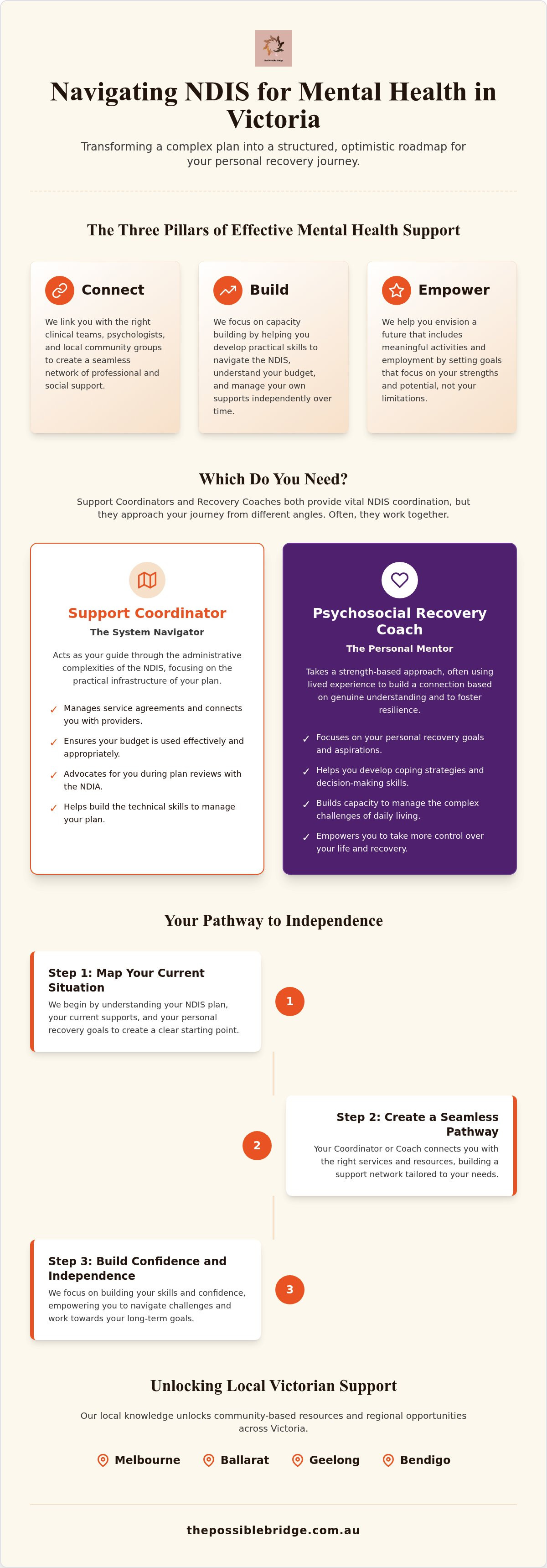
The Three Pillars of Effective Mental Health Support
To create lasting change, we focus on three core areas that work together to strengthen your recovery. These pillars ensure your NDIS plan translates into real-world progress in Melbourne, Ballarat, or Bendigo.
- Connect: We link you with the right clinical teams, psychologists, and local community groups. This creates a seamless network of care that surrounds you with professional and social support.
- Build: We focus on capacity building. This involves developing the practical skills you need to navigate the NDIS independently. Our goal is to help you understand your budget and manage your own supports over time.
- Empower: We look at your potential. By setting goals that focus on your strengths rather than your limitations, we help you envision a future that includes meaningful activities and employment.
By focusing on these pillars, NDIS coordination for mental health becomes a collaborative process. It's about finding new opportunities and building the confidence to seize them. We're here to guide you through the technicalities so you can focus on what matters most: your wellbeing and your future.
Support Coordination vs. Psychosocial Recovery Coaching: Which Do You Need?
One of the most frequent questions we hear is whether someone needs a Support Coordinator or a Psychosocial Recovery Coach. While they both provide NDIS coordination for mental health, they approach your journey from different angles. It's not always a choice between one or the other; often, they work together to create a comprehensive support net. While a Support Coordinator organises the system, a Recovery Coach focuses on the resilience needed to thrive within it.
The Role of a Support Coordinator
Your Support Coordinator acts as your navigator through the administrative complexities of the NDIS. They focus on the practical infrastructure of your plan. This involves managing service agreements, connecting you with reputable providers, and ensuring your budget is being used effectively. They're also your advocate during plan reviews, preparing detailed reports for the NDIA to ensure your funding aligns with your needs. If a barrier arises, such as a provider not meeting your expectations, your coordinator steps in to problem-solve and find a better fit. They help you build the technical skills to manage your plan with confidence.
The Role of a Psychosocial Recovery Coach
A Recovery Coach takes a more personal, strength-based approach. Many coaches have lived experience of mental health challenges, allowing them to build a connection based on genuine understanding. According to the official NDIS guidelines for mental health, this role is specifically designed to support people with psychosocial disabilities. They help you create a "Recovery Plan," which is a personal document that sits alongside your NDIS plan. This coaching focuses on increasing your motivation, building your engagement with the community, and fostering the skills needed to manage the ups and downs of life. It's about finding your voice and taking the lead in your own story.
Finding the Right Balance
In your NDIS plan, these services are funded under different line items. Support Coordination is usually listed under "Support Coordination," while coaching is found under "Psychosocial Recovery Coaching." Having both can be incredibly powerful. Your coordinator builds the bridge by setting up the services, while your coach helps you find the strength to walk across it. This dual approach ensures that while the "red tape" is handled, your personal growth remains the priority in your NDIS coordination for mental health. It creates a steady, reliable environment where you can focus on building a life beyond your diagnosis. If you're unsure which path is right for your current situation, exploring our approach to recovery can help clarify how these roles fit into your life.
Designing Your Path: The Coordination Process for Mental Health Recovery
Transforming an NDIS plan into a lived reality requires a clear, methodical roadmap. We don't believe in a one-size-fits-all approach; instead, we focus on a collaborative journey that respects your pace and your priorities. This process is about building a bridge from where you are today to where you want to be tomorrow. By following a structured path, NDIS coordination for mental health becomes a tool for empowerment rather than just another administrative requirement.
Our coordination process follows five essential steps designed to create stability and momentum:
- Step 1: Listen and Learn. We begin with an initial meeting to understand your story, your strengths, and your aspirations. This conversation forms the blueprint for everything that follows.
- Step 2: Map Your Network. We identify your current supports, including your GP, psychologist, and family members. This ensures everyone is working toward the same goals.
- Step 3: Identify the Gaps. We look at what is missing. Whether it's social connection, transport, or daily living assistance, we find the pieces needed to complete your support puzzle.
- Step 4: Connect and Engage. We link you with community-based activities and employment pathways that align with your interests. This is where your world begins to expand.
- Step 5: Review and Adjust. Recovery isn't a straight line. We regularly review your progress and adjust your supports as you grow, ensuring the bridge remains strong and relevant.
Setting Goals for Independence and Employment
Meaningful work is often a cornerstone of mental health recovery. It provides structure, social connection, and a sense of achievement. Our coordination services facilitate the transition into workplace readiness by helping you access specific NDIS Employment Supports. We work with you to build the confidence needed to enter or re-enter the Victorian workforce. By linking your recovery goals with professional aspirations, we help you create a sustainable lifestyle that values your contribution and fosters long-term independence.
Managing the Episodic Nature of Mental Health
We recognise that mental health challenges can fluctuate. There will be days of great progress and days that require more care. While we are not a 24/7 crisis intervention service, we are dedicated partners in your long-term stability. We help you create a proactive "wellness plan" that outlines how to scale your supports up or down based on your current wellbeing. This ensures continuity of care throughout different phases of your recovery. Your coordinator acts as a steady influence, helping you navigate the system so you can focus on maintaining your health and staying connected to your community in Melbourne, Ballarat, or Bendigo.
Local NDIS Support in Victoria: Melbourne, Ballarat, and Bendigo
Effective NDIS coordination for mental health requires more than just a deep understanding of the NDIS Pricing Schedule; it demands a genuine connection to the streets, suburbs, and services where you live. While a national provider might offer a broad perspective, they often lack the ground-level insight needed to find that specific community garden in Ballarat or a peer-led support group in Bendigo. In Melbourne, our coordination efforts focus on navigating the dense metropolitan resource network, connecting you with specialised vocational training and diverse social hubs. We position ourselves as your local guide, ensuring your plan isn't just a document, but a gateway to your local Victorian community.
Connecting with the Ballarat and Bendigo Communities
Living in regional Victoria brings a unique set of opportunities and challenges. In Ballarat and Bendigo, accessing the right support often depends on knowing the local health pathways and the people who manage them. We focus on linking you with regional community hubs and established peer support networks that provide a sense of belonging. Navigating services in Geelong or other regional centres shouldn't feel like an uphill battle. A coordinator with local roots understands how to bridge the gap between regional disability support access and metropolitan-level resources, ensuring you never feel isolated by your geography. This local knowledge helps us build a support net that is practical, accessible, and deeply rooted in your own neighbourhood.
Why a Local Victorian Provider Matters
The Victorian mental health landscape is currently undergoing significant reform, following the Royal Commission into Victoria’s Mental Health System. This context is vital for anyone seeking NDIS coordination for mental health. A local provider understands these structural changes and how they impact your access to state-funded services alongside your NDIS plan. Unlike a national call-centre, we offer face-to-face connection that builds trust, rapport, and understanding. We spend our time building a network of trusted local providers in your own backyard, from small community organisations to specialised employment services. This proximity allows for a level of responsive, human-centric care that digital-only services simply cannot replicate. We believe in the power of local connection to foster stability, growth, and long-term recovery. This local presence ensures that your support net is woven from the very community you call home.
If you're ready to move beyond generic support and find a partner who understands your local Victorian community, connect with our regional coordination team today to start building your pathway forward.
Starting Your Journey with The Possible Bridge
At The Possible Bridge, we believe your NDIS plan is a foundation for growth rather than a limit on your life. Finding the right NDIS coordination for mental health is about discovering a partner who sees your potential even on the difficult days. We act as your guide, your advocate, and your steady hand throughout the recovery process. Whether you are living in Melbourne, Ballarat, Bendigo, or Geelong, we offer a pathway that prioritises your voice and your vision. Our commitment is to remain a reliable mentor who is both practical about the steps required for growth and optimistic about your eventual outcomes.
Switching your coordination to our team is a straightforward and stress-free process. You don't need to wait for a scheduled plan review to make a change; you have the right to choose a provider that best fits your needs at any time. We handle the transition with care, ensuring there is no gap in your support network. During our first conversation, we simply listen. You can bring your current NDIS plan, your list of personal goals, and any questions you have about the system. We'll explore what's working, what's missing, and what you hope to achieve in the coming months. This first step is about building trust and understanding your unique story.
Our Approach to Psychosocial Support
We focus on person-centred planning that respects your individual pace and priorities. Recovery isn't a race; it's a steady, methodical progression toward a life you value. Our approach to NDIS coordination for mental health focuses on building a future that includes meaningful work, social connection, and daily independence. By creating seamless pathways to your goals, we ensure every part of your plan serves your long-term vision. We connect you to resources, build your internal capacity, and empower you to take the lead in your own life. This tripartite focus ensures a balanced and complete support experience.
Ready to Cross the Bridge?
Taking the first step toward a new support partnership can feel daunting, but you don't have to navigate it alone. We're here to reassure you that we handle the "heavy lifting" of NDIS administration, from service agreements to provider research. This allows you to focus your energy on your wellbeing and personal progress. We offer a confidential space to discuss your needs and map out a way forward together. If you're looking for a team that is locally rooted and deeply invested in your recovery, we're ready to start that journey with you. Organise a consultation with our Victorian team to discover how we can help you build a more independent life.
Building Your Pathway to Independence
Navigating your NDIS plan shouldn't feel like a solo journey through a thicket of red tape. By choosing specialised NDIS coordination for mental health, you're securing a dedicated partner who understands the episodic nature of recovery and the importance of community connection. We've explored how the synergy between coordination and recovery coaching creates a robust support net; one that manages administrative complexities while fostering your personal resilience. Whether you're based in Melbourne or regional hubs like Ballarat, Bendigo, and Geelong, local expertise ensures you're linked to the right resources at the right time.
As an NDIS Registered Provider and specialist in psychosocial recovery, we're committed to helping you move from clinical management toward a life of purpose and independence. We handle the heavy lifting of the system so you can focus on your strengths, your goals, and your future. We believe in your potential and are ready to walk alongside you as you build a life that is meaningful and self-directed.
Begin your recovery journey with The Possible Bridge today. Your progress is our priority, and we're ready to help you cross that bridge with confidence and calm.
Frequently Asked Questions
What is the difference between a support coordinator and a case manager?
A support coordinator focuses on helping you understand and implement your NDIS plan, whereas case managers often focus on clinical oversight or medical treatment. In the NDIS context, coordination is about navigating the system, managing service agreements, and building your capacity to lead your own recovery. It's a collaborative partnership designed to empower you with choice and control, rather than a clinical oversight role that manages your health decisions for you.
Can I have both a support coordinator and a recovery coach in my NDIS plan?
Yes, it's possible to have both services funded in your plan if they're deemed reasonable and necessary by the NDIA. While a coordinator handles the administrative and system-navigation side, a psychosocial recovery coach focuses on your strength-based recovery and motivation. They work in tandem to provide a comprehensive support net. This dual approach is often highly effective for participants with complex psychosocial needs in Melbourne or regional Victoria.
How do I get NDIS coordination for mental health added to my plan?
You need to request this support during your planning meeting or plan review with the NDIA. You'll need to explain why you require help to coordinate your supports, specifically highlighting the episodic nature of your psychosocial disability. Providing evidence from your GP or psychologist can strengthen your case. Securing NDIS coordination for mental health ensures you have a dedicated partner to help you navigate the system and access local Victorian resources.
Does The Possible Bridge provide clinical psychology or crisis housing?
No, we don't provide clinical psychology or 24/7 crisis intervention services. Our focus is strictly on Support Coordination, Psychosocial Recovery Coaching, and Employment Supports. We act as your guide to connect you with clinical professionals and housing providers who specialise in those areas. Our role is to bridge the gap between these essential services, ensuring your support network is cohesive, reliable, and aligned with your personal recovery goals.
I live in Ballarat; can I meet my support coordinator in person?
Yes, we pride ourselves on being a locally rooted provider with a strong regional presence. If you live in Ballarat or Bendigo, you can certainly meet your coordinator in person. We believe face-to-face connection is vital for building a steady, reliable partnership based on trust. Unlike national call-centre services, we value the rapport that comes from sitting down together and discussing your progress within your own local community.
Will my support coordinator help me find a job?
While your coordinator focuses on the infrastructure of your plan, they'll actively link you with our specialised Employment Supports. We believe meaningful work is a powerful pillar of recovery and independence. Your coordinator helps you access the right funding and connections, while our employment team works with you on workplace readiness. This collaborative approach helps you move toward long-term contribution and confidence within your local Victorian community.
What happens if my mental health changes and I need more support suddenly?
We understand that mental health can be episodic and unpredictable. If your needs increase, your coordinator will help you scale your supports up by liaising with your current providers or finding additional services. While we aren't a crisis service, we act quickly to adjust your plan's implementation. This flexibility ensures you have a safety net during difficult patches, providing a steady and calming influence when you need it most in Melbourne or Geelong.
Is NDIS coordination free for participants?
NDIS coordination is funded directly through your plan, so there's no out-of-pocket cost to you as long as the service is included in your budget. The NDIA sets specific price limits for these services in the NDIS Pricing Schedule. Using your funding for NDIS coordination for mental health allows you to access professional expertise without financial stress. This ensures you can focus your energy entirely on your recovery journey and personal growth.

