

Receiving your National Disability Insurance Scheme (NDIS) plan is a significant milestone. It represents possibility, opportunity, and a pathway toward your goals. But the plan itself is just the beginning. The next, most crucial step is turning that document into a tangible reality—a network of supports, services, and community connections that actively improves your life.
This is where an NDIS Support Coordinator becomes your most valuable partner. Far more than just an administrator, a skilled coordinator acts as your strategist, your advocate, and your guide. They are the professional who helps you navigate the complexities of the NDIS, make informed choices, and build the momentum you need to achieve genuine independence.
Discover how a dedicated NDIS support coordinator helps you activate your plan, connect with quality providers across Victoria, and build the purpose-driven life you deserve.
What is an NDIS Support Coordinator?
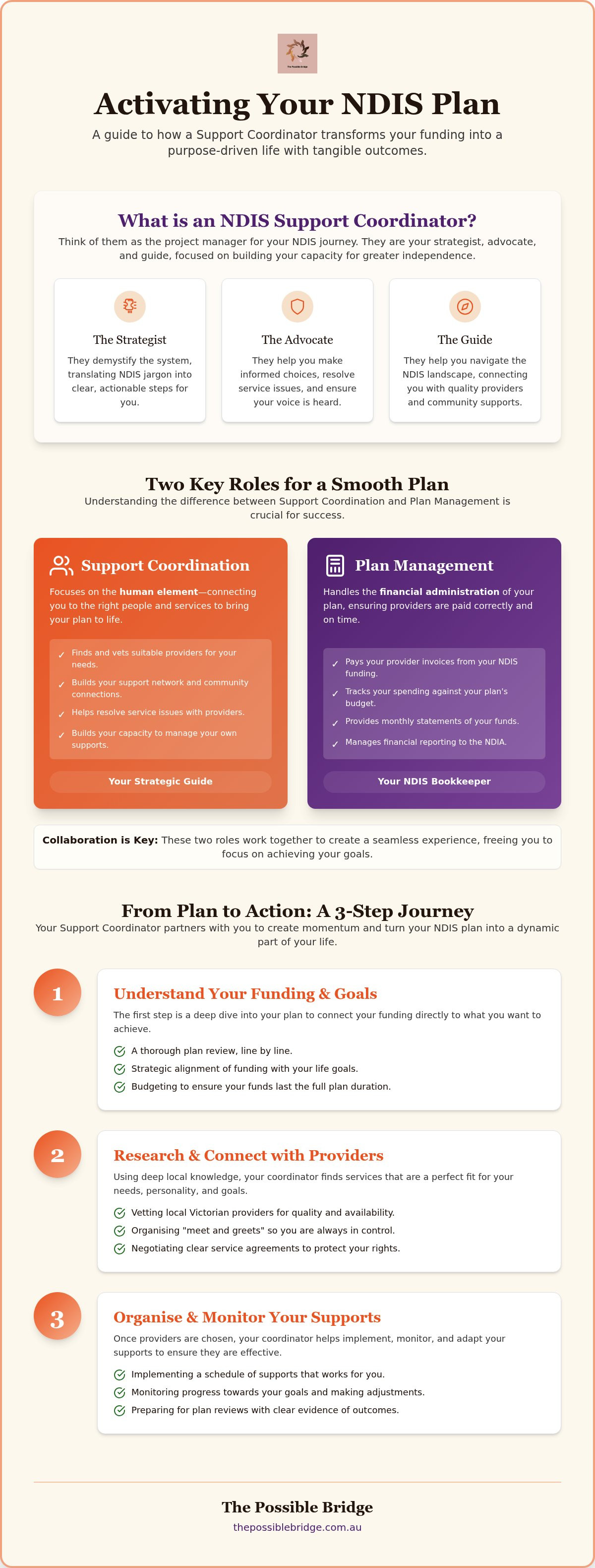
An NDIS Support Coordinator is a funded professional whose role is to help you understand, navigate, and implement your NDIS plan effectively. Think of them as the project manager for your NDIS journey. While you are always in control, your coordinator provides the expertise and resources to ensure your plan is managed efficiently and aligned with your personal goals.
Their primary focus is on capacity building—equipping you with the skills, knowledge, and confidence to manage your own supports over time. They work with you, not for you, to transform your plan’s funding into the right services at the right time. Ultimately, their role is a capacity-building support designed to increase your independence and help you get the most out of your NDIS funding.
The Strategist: Moving Beyond the Jargon
The NDIS is filled with specific terminology and complex guidelines that can feel overwhelming. A great support coordinator demystifies the system, translating bureaucratic language into practical, actionable steps. They help you move from confusion to clarity.
- Breaking down your plan: They sit with you to analyse each support category, explaining what the funding can be used for and how it connects to your specific goals.
- Explaining “reasonable and necessary”: They provide context for this core NDIS principle, helping you understand how to request supports that meet the NDIA’s criteria and align with your disability-related needs.
- Strategic goal setting: They work with you to prioritise your goals, helping you sequence your supports logically to build a foundation for long-term achievements, like finding a job or moving into your own home.
Support Coordination vs. Plan Management
It’s common for new NDIS participants to confuse Support Coordination with Plan Management, but they are two distinct and equally important roles. Understanding the difference is key to a smoothly run plan.
- Support Coordinators manage connections: They focus on the human element—finding providers, building your support network, resolving service issues, and building your capacity to navigate the system. They are your strategic guide.
- Plan Managers handle the finances: They manage the financial side of your plan, paying your provider invoices, tracking your spending, and providing monthly statements. They are your NDIS bookkeeper.
Many participants have funding for both. The two roles collaborate closely: your Support Coordinator helps you choose a provider and negotiate a service agreement, and your Plan Manager ensures that provider gets paid correctly and on time. This partnership creates a seamless experience, freeing you to focus on your goals.
Turning Your NDIS Plan into Action
A support coordinator’s true value lies in their ability to create forward momentum. They are the catalyst that transforms your NDIS plan from a static document into a dynamic, active part of your life. This process is a collaborative partnership built on trust, clear communication, and a shared focus on your strengths and aspirations.
A good coordinator ensures your NDIS funding is used strategically to achieve meaningful outcomes. They don’t just connect you to services; they help you build a coordinated and effective support system that works for you. The entire process is designed to move you steadily toward a more independent and fulfilling future.
Step 1: Understanding Your Funding and Goals
The first step is a deep dive into your NDIS plan. Your coordinator will sit down with you (and your family or support network, if you wish) to gain a complete understanding of what the NDIA has funded and, more importantly, what you want to achieve.
- A thorough plan review: Together, you’ll go through your plan line by line, identifying the specific budget allocated for "Support Coordination" and other support categories like Core Supports, Capacity Building, and Capital Supports.
- Strategic alignment: This is about connecting the dots. Your coordinator helps you map your funding directly to your life goals. If your goal is to find employment, they help you identify how your funding can be used for therapies, transport training, or skill development programs that build a pathway to work.
- Budgeting for the long term: They help you pace your spending to ensure your funding lasts the full duration of your plan, avoiding the stress of running out of funds for essential services.
Step 2: Researching and Connecting with Providers
With a clear strategy in place, your coordinator begins the crucial work of finding the right providers. This goes far beyond a simple Google search. They use their professional networks and deep knowledge of the local service landscape to find supports that are a perfect fit for your needs, personality, and goals.
- Vetting local providers: Whether you’re in metropolitan Melbourne, Geelong, Ballarat, or Bendigo, your coordinator does the due diligence. They find providers with a good reputation, check their availability, and ensure they have the right skills and qualifications to support you.
- Organising "meet and greets": You are always in control. Your coordinator will set up introductory meetings, allowing you to interview potential support workers or therapists to ensure you feel comfortable and confident in your choice.
- Negotiating service agreements: They assist you in establishing clear service agreements with your chosen providers. This formal document outlines exactly what supports will be delivered, when, and at what cost, protecting your rights and ensuring everyone is on the same page.
Step 3: Organising and Monitoring Your Supports
Once your providers are chosen, the coordinator helps implement your support schedule and, critically, monitors its effectiveness over time. Their job isn’t finished once the services start; in many ways, it’s just beginning.
- Building your weekly rhythm: They help set up your initial schedule of services, creating a structured and predictable routine that supports your well-being and helps you progress toward your goals.
- Quality assurance and feedback: A great coordinator regularly checks in with you to ask: "Is this working?" They create a safe space for you to provide honest feedback about your services and will act as your advocate if things aren't going as planned.
- Proactive problem-solving: If a provider isn't a good fit or a service isn't delivering the expected outcomes, your coordinator steps in to resolve the issue swiftly. This might involve mediating a conversation, finding an alternative provider, or adjusting your support strategy.
The Three Levels of NDIS Support Coordination
The NDIA understands that participants have different levels of need when it comes to managing their plans. To accommodate this, Support Coordination is funded at three distinct levels. The level you receive in your plan is based on the complexity of your situation and the amount of assistance you require. Understanding these levels can help you advocate for the right support during your planning meetings and reviews.
It's important to note that Level 2, Coordination of Supports, is the most common allocation for participants who require ongoing assistance to manage their support environment.
Level 1: Support Connection
This is a short-term level of support designed to help you get started on your NDIS journey. It’s for participants who have the capacity to manage their plan but need some initial, targeted assistance to make connections.
- Focus: Its primary aim is to increase your ability to connect with informal, mainstream, and funded supports, helping you build a network and understand how to use the NDIS portal.
- Best for: Imagine you’re new to the NDIS and just need a little "nudge" to get your plan moving. A Support Connector can help you find a local therapist or social group, empowering you to manage the rest independently.
Level 2: Coordination of Supports
This is the most common level of support coordination and provides more ongoing assistance. It’s designed for participants who need help managing a more complex range of supports and providers.
- Focus: The goal is to build your capacity to maintain relationships with providers, live more independently, and manage potential crises. It involves more in-depth problem-solving and stakeholder engagement.
- Best for: Consider a participant who uses multiple providers for therapy, in-home care, and community access. A Level 2 Coordinator helps manage all these moving parts, ensures the services are working together, and provides crucial assistance in preparing for your annual NDIS plan review.
Level 3: Specialist Support Coordination
This is the highest level of support, delivered by a professional with specialist qualifications and experience. It is funded for participants with very complex situations or high-risk needs who require expert guidance.
- Focus: A Specialist Support Coordinator manages challenges across multiple government systems, such as health, justice, child protection, or housing. They develop and implement comprehensive support plans to address significant barriers.
- Best for: This level is for a participant navigating complex interactions with the justice system while also managing their disability supports. A Specialist Coordinator has the expertise to manage these high-stakes relationships, develop a crisis management plan, and ensure a safe and stable support environment.
The Power of a Local Partner in Victoria
The NDIS is a national scheme, but its success is delivered locally. The best support is not "one size fits all"; it's deeply rooted in your local community, whether that’s a bustling Melbourne suburb or a regional centre like Geelong, Ballarat, or Bendigo. A support coordinator with genuine local knowledge offers a significant advantage, turning a generic plan into a highly personalised and effective support network.
A coordinator who lives and works in your area understands the nuances of the local service landscape. They know the "hidden gem" providers that larger, national directories often miss. This local insight means they can connect you with services that are not only high-quality but also a great cultural and personal fit.
Navigating the Victorian Service Landscape
A Victorian-based partner understands the unique ecosystem of services available across the state. They can help you connect the dots between the NDIS and other state-based systems, creating a more holistic support structure.
- Understanding local networks: They have established relationships with providers across Melbourne and regional Victoria, which can help you navigate waitlists and find services with immediate capacity.
- Navigating practical challenges: They understand local transport systems, from Melbourne’s tram network to V/Line services in regional hubs, ensuring your support plan is practical and that you can actually get to your appointments.
- Connecting state and federal supports: They have a working knowledge of the Victorian health, housing, and education systems, helping you integrate your NDIS plan with other essential mainstream services for a truly wrap-around approach.
Building Real Relationships, Face-to-Face
While technology allows for remote support, there is undeniable power in local, personal connection. Having a coordinator who can meet with you in person builds a level of trust and understanding that purely phone-based services often struggle to match.
- Deeper understanding: Face-to-face meetings allow your coordinator to gain a richer understanding of your life, your environment, and your non-verbal cues, leading to a more intuitive and responsive support strategy.
- Stronger advocacy: A local coordinator can attend meetings with you, whether it’s with a new provider or at a school or healthcare facility, providing in-person advocacy and support when you need it most.
- Investing in your community: By connecting you with local Victorian providers, your coordinator is also helping to support the local economy and build a stronger, more resilient community for everyone.
Building Your Future with The Possible Bridge
At The Possible Bridge, we see support coordination as the foundational element of your NDIS journey. It’s the essential first step in building a stable, supportive, and empowering life. We see ourselves as the "bridge" between the plan you have today and the future you want to create—a future defined by independence, purpose, and connection.
Our approach is built on three pillars: understanding your plan, connecting you with quality supports, and building your capacity for long-term success. We are not just service brokers; we are dedicated partners who invest in your potential. Our communication is always steady, optimistic, and focused on helping you take the next step forward.
Specialists in Psychosocial Recovery
We have deep expertise in supporting participants with a psychosocial disability. Our Support Coordinators are not only NDIS experts; they are trained to understand the unique, and often fluctuating, challenges of managing mental health. They work hand-in-glove with our Psychosocial Recovery Coaches to create a consistent, wrap-around support system.
- A cohesive team approach: Our coordinators and coaches collaborate to ensure your support network is stable, understanding, and responsive to your needs.
- Creating a safe environment: We focus on building a trusting relationship that encourages you to set meaningful goals and work toward them at your own pace.
- Building resilience: Our goal is to help you build a network of formal and informal supports that understands the ups and downs of recovery, fostering stability and hope.
Pathways to Employment and Independence
A stable life is the launchpad for a fulfilling career. We believe that effective support coordination is the critical groundwork for achieving your employment aspirations. By getting the foundations right, we help you build the confidence and structure needed to pursue your professional goals.
- Laying the groundwork: Our coordinators help organise reliable transport, therapeutic supports, and skill-building activities that prepare you for the workforce.
- A seamless transition: We create a smooth pathway from our Support Coordination service to our specialised Employment Supports, ensuring you have consistent and knowledgeable guidance every step of the way.
- Take the first step: Ready to turn your NDIS plan into a plan for a better future? Organise a chat with our supportive team today.
Frequently Asked Questions
- Is an NDIS support coordinator the same as a support worker?
- No, they are different roles. A support worker provides direct, hands-on assistance with daily tasks (like personal care, travel, or community access). A support coordinator is a strategic role focused on helping you manage your overall NDIS plan, find providers, and build your capacity to coordinate your own supports.
- How do I get support coordination added to my NDIS plan?
- You need to request it from the NDIA during your planning meeting or plan review. You should provide evidence explaining why you need this support. This could include having multiple complex needs, dealing with many different providers, having limited informal supports (like family), or facing significant barriers to implementing your plan on your own.
- Can I choose my own support coordinator in Melbourne or Ballarat?
- Yes, absolutely. The NDIS is built on the principle of choice and control. You have the right to choose which provider delivers your support coordination. It’s important to find a coordinator you trust and feel comfortable working with, whether they are based in Melbourne, Ballarat, Geelong, Bendigo, or elsewhere in Victoria.
- What happens if I don’t have support coordination in my plan?
- If you don’t have funding for support coordination, you will be responsible for implementing your plan yourself. This includes researching and contacting providers, managing service agreements, and handling any issues that arise. You can also get assistance from an NDIS Local Area Coordinator (LAC) to help you get started.
- Can a support coordinator help me find a job in Victoria?
- Yes, indirectly and directly. A support coordinator can help you lay the essential groundwork for employment by connecting you with services that build your skills, confidence, and stability. They can also connect you with specialised Disability Employment Services (DES) or, in the case of The Possible Bridge, provide a seamless pathway to our own dedicated Employment Supports team.
- How much does an NDIS support coordinator cost?
- If it’s included in your plan, there is no out-of-pocket cost to you. The service is paid for directly from your NDIS funding at the hourly rate set by the NDIS Pricing Arrangements and Price Limits. The funding for Support Coordination is a separate, stated item in your Capacity Building budget and does not take away from funding for your other supports.
- What is the difference between a recovery coach and a support coordinator?
- While both roles support you, a Psychosocial Recovery Coach has specialist knowledge and skills in mental health recovery. They focus specifically on coaching you to take more control of your life and better manage the complex challenges of day-to-day living. A Support Coordinator has a broader focus on implementing your entire NDIS plan, which may include but is not limited to your mental health needs.
- How often will I meet with my support coordinator?
- This depends entirely on your needs and what is agreed upon when you start. In the beginning, you might meet more frequently to get everything set up. Once your supports are running smoothly, you may connect less often, such as monthly or quarterly, to check in on your progress and prepare for your plan review. The frequency is flexible and should be tailored to you.

