

What if the first step towards NDIS support isn’t choosing a provider, but understanding how the scheme works? If you’re asking “what is ndis”, you’re not alone. Unfamiliar terms and questions about what funding can cover can make it hard to know where to begin. The National Disability Insurance Scheme (NDIS) funds supports for eligible Australians with permanent and significant disability, with plans shaped around individual needs and goals.
It helps to separate applying for the NDIS from choosing services. Access comes first; deciding how to use an approved plan comes later. This guide explains the scheme’s purpose, how funding and plans work, and the broad steps from checking access through to using a plan. It also explains why NDIS funding doesn’t cover every service or expense.
If you’re in Victoria, your next step will depend on your circumstances and goals. Support coordination, employment supports or psychosocial recovery coaching may be relevant for some participants. We’ll explain where these services fit, so you can consider your options without assuming that every service is right for everyone or covered by a plan.
Key Takeaways
- Learn what is ndis and how the scheme connects eligible participants with disability-related supports.
- Follow the broad pathway from exploring access to making a request and using an approved plan.
- Check whether a support aligns with your plan and current NDIS rules before making decisions about funding.
- Use your plan to identify priorities, ask questions and compare options against your goals.
- Explore whether Victorian support coordination, employment supports or psychosocial recovery coaching could help with your next step.
What is the NDIS and what is it designed to do?
The National Disability Insurance Scheme (NDIS) is Australia’s national scheme for funding disability-related supports for eligible people with permanent and significant disability. It is administered by the National Disability Insurance Agency (NDIA), which makes decisions about access and participant plans. If you’re searching “what is ndis”, the key point is that the scheme is designed around individual needs and goals, rather than providing everyone with the same package of services.
NDIS funding is for supports that meet the scheme’s requirements and relate to a participant’s disability and plan. It isn’t the same as general health care, income support or disability advocacy. Health services and the NDIS have different roles, and the NDIS isn’t a general payment for everyday living costs. Advocacy organisations can help people understand or express their views, but that role is separate from the NDIS and its funding decisions. For background on the scheme’s history and structure, see this overview of the National Disability Insurance Scheme (NDIS).
Who is the NDIS intended to support?
The NDIS is intended for people with disability who meet the current access requirements. Having a disability doesn’t automatically mean someone receives NDIS funding; access is assessed against the scheme’s criteria. Requirements and application details can be difficult to interpret, so check the NDIS eligibility guide for a more detailed explanation of who may qualify and how to explore an access request.
What does the NDIS aim to make possible?
The scheme can fund supports intended to help participants pursue goals, build skills and take part in everyday life. What that means differs from person to person. One participant may focus on greater independence, employment or community participation; another may have different priorities. The focus is on the participant’s needs and aspirations, rather than treating disability as something to fix.
A plan may include different types of support, subject to the participant’s circumstances and current NDIS rules. The scheme is broader than purchasing services from one provider. Participants can consider which supports suit their goals, then check that proposed spending aligns with their plan. For someone in Ballarat, a local provider may be one part of the picture, alongside personal choices, community connections and other supports.
How does the NDIS work, from access to an individual plan?
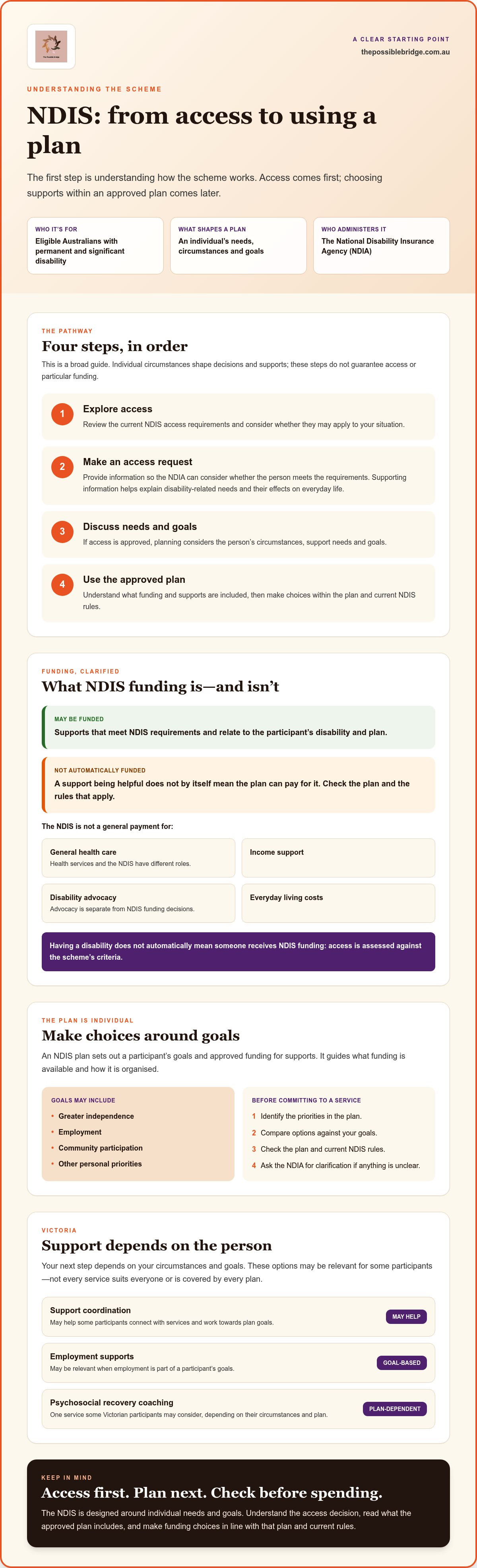
Knowing the broad pathway can make the scheme easier to navigate. It moves from checking whether someone may meet access requirements, to making an access request, planning with the NDIA if access is approved, and then using the resulting plan. Each person’s circumstances shape the decisions and supports considered. These steps are a general guide, not a promise of access or particular funding.
In practical terms, the pathway looks like this:
- Explore access. Review the current NDIS access requirements and consider whether they may apply to your situation.
- Make an access request. Provide information so the NDIA can consider whether the person meets the requirements.
- Discuss needs and goals. If access is approved, planning involves considering the person’s circumstances, support needs and goals.
- Use the approved plan. Check what funding and supports are included, then make choices within the plan and current NDIS rules.
What happens when someone seeks NDIS access?
An access request asks the NDIA to consider whether a person is eligible. Supporting information helps decision-makers understand the person’s disability-related needs and how these affect everyday life. The evidence and process depend on individual circumstances, so don’t rely on old forms or someone else’s experience as a definitive guide. For detailed criteria and application guidance, see the complete NDIS access and eligibility guide.
What is an NDIS plan for?
An NDIS plan is an individual framework that sets out a participant’s goals and approved funding for supports. It guides what funding is available and how it is organised. A support that seems helpful isn’t automatically funded. Whether it can be paid for depends on the participant’s plan and the rules that apply. Before committing to a service, check the plan and ask the NDIA for clarification if anything is unclear.
Once a plan is in place, take time to understand its priorities and funding arrangements. Support coordination may help some participants connect with services and work towards plan goals, while others may not need it. If you’re considering local guidance in Ballarat, you can learn about The Possible Bridge’s NDIS supports, including support coordination, employment supports and psychosocial recovery coaching. These are options to explore, not services every participant needs or is funded to use.
What can NDIS funding cover, and what should participants check?
NDIS funding isn’t a general-purpose budget. A support needs to fit the participant’s plan and the NDIS rules that apply. A provider may offer a service, but that doesn’t by itself mean it can be paid for with NDIS funds. The participant’s goals, plan funding and circumstances all matter.
Use the examples below to identify questions to ask, not as a list of guaranteed approvals or exclusions. Consider both the purpose of a support and how it fits the individual plan.
| Support purpose | What to consider about plan fit | What to verify |
|---|---|---|
| Building skills for work | Employment assistance may relate to a participant’s work goals, but the service must fit their plan and current rules. | Check the relevant funding, the support’s purpose and whether the provider’s service matches what’s approved. |
| Recovery-related support | Psychosocial recovery coaching may help someone work towards personal goals. Its availability from a provider doesn’t confirm NDIS funding. | Review the plan and confirm that this type of support and the proposed arrangement are appropriate. |
| Health care or everyday expenses | These expenses can require careful consideration; don’t assume that a cost is funded or unfunded based on its label alone. | Check the current NDIS guidance and ask the NDIA or an appropriate adviser about the specific situation. |
How do plan management options affect provider choice?
NDIS plans can be self-managed, plan-managed or NDIA-managed. With self-management, the participant or their nominee manages payments and records. With plan management, a plan manager handles payment administration. Under NDIA management, the NDIA manages payments to providers, and provider choice may be affected by registration requirements. Check the current rules and the participant’s plan before arranging a support. The Possible Bridge doesn’t provide NDIS plan management.
How can participants check whether a support fits their plan?
Start with the plan. Identify the relevant funding and any stated limits or conditions. Then compare the proposed service with the participant’s goals and check current NDIS guidance. If anything is unclear, ask the NDIA or another appropriate decision-maker before agreeing to costs. Employment assistance or recovery-related support may be worth asking about when it aligns with a participant’s goals, but funding depends on individual circumstances and plan details.
A search for “what is ndis” often leads to a practical question: “Can my plan pay for this?” The answer depends on the specific support and plan, not just a provider’s service list or a general rule of thumb.
What should you do after receiving an NDIS plan?
A plan gives you a starting point, not a list of decisions you have to make at once. Read what’s included, how the funding is arranged and what the plan says about your goals. If the wording is unclear, note your questions and seek clarification before committing to a service.
Begin with what matters in everyday life. You might want to explore work, build confidence to take part in community activities, or connect with supports related to a personal goal. Your priorities belong at the centre of the conversation. Ask questions, consider options and share your preferences before deciding whether a service feels right.
How can a participant choose supports that fit their goals?
When comparing services, look beyond the service name. Ask what the support involves, how the provider communicates, whether their availability suits your circumstances and how their approach relates to your goals. Confirm that the proposed support fits your plan, and understand any responsibilities or costs before starting. A provider can explain its services, but the participant’s plan and current NDIS rules determine whether funding can be used.
Choice also means having room to consider alternatives. A family member, trusted person or advocate may be able to help you think through questions if you want their involvement. Make sure your preferences and consent guide those discussions.
When might support coordination be useful?
Support coordination may help a participant understand their plan, connect with providers and link in with relevant community resources. It isn’t needed by everyone, and whether it’s available or funded depends on the individual plan and current rules. Community connections can complement funded supports too, such as groups or other resources that match a person’s interests and goals.
For a local example of how people can think through provider options, read this guide to NDIS provider options in Geelong. The same questions about service fit and personal priorities can help participants in Ballarat. A search for “what is ndis” may be the beginning; understanding your plan and identifying a manageable next step can help turn that knowledge into action.
If support coordination, employment supports or psychosocial recovery coaching may relate to your goals, explore The Possible Bridge’s NDIS supports as one option to consider.
Where can Victorian NDIS participants find support for their next step?
Local providers can be one part of a participant-led support network. They aren’t the NDIS or the agency that decides access and funding. Their role is to deliver agreed services that may help a participant work towards personal goals, alongside other supports and community connections suited to their circumstances.
The Possible Bridge provides support coordination, employment supports and psychosocial recovery coaching. Its stated Victorian service areas include Melbourne, Ballarat, Geelong, Bendigo and surrounding regions. Availability can change, so check whether the service you’re considering is currently available in your area and appropriate to your plan.
What support does The Possible Bridge provide?
Each service has a different focus. Whether it’s relevant depends on the participant’s goals and plan:
- Support coordination can help connect a participant’s goals with services and community resources.
- Employment supports can assist with building skills and pursuing work goals.
- Psychosocial recovery coaching can support a person to work towards recovery-related goals.
These supports aren’t a standard package, and not every participant will need them. Start by identifying what the person wants to work towards, then check what their plan allows.
How can someone take a considered next step?
Before contacting a provider, note down a few questions. What goals matter most right now? Which support, if any, might help? Does the plan appear to include suitable funding, and what needs to be confirmed before starting? You can also ask about the service’s scope, how communication works and whether it’s available where you live.
Check current NDIS guidance and the participant’s plan rather than assuming a service will be funded. If you’re unsure, seek clarification before making commitments. A provider can explain its services and availability, but it can’t guarantee that the NDIS will fund a particular support.
If your search for “what is ndis” has led you to consider local options, there’s no need to rush. A conversation can help you explore whether support coordination, employment supports or psychosocial recovery coaching may relate to your goals. Explore support options with The Possible Bridge when you’re ready.
Take your next step with clarity
Understanding what is ndis means recognising both the scheme’s purpose and its boundaries. It funds eligible participants’ disability-related supports, while access and plan decisions depend on individual circumstances and current rules. Knowing the broad pathway, from exploring access to checking a plan before choosing supports, can make the next decision easier.
Start with the participant’s goals. Read the plan, note what needs clarification and check whether a proposed service fits before making arrangements. Local providers may be one part of a wider support network, alongside personal and community connections.
The Possible Bridge offers support coordination, employment supports and psychosocial recovery coaching. Its stated Victorian areas include Melbourne, Ballarat, Geelong and Bendigo, though current service availability should be confirmed. These options won’t suit everyone, and whether a support can be funded depends on the participant’s plan and applicable NDIS rules.
If you’d like to explore whether these services may relate to your goals, Explore support options with The Possible Bridge. Take the time you need to ask questions and find a path that feels right for you.
Frequently Asked Questions
What does NDIS stand for?
NDIS stands for National Disability Insurance Scheme. It’s Australia’s national scheme for funding disability-related supports for eligible people with permanent and significant disability. The National Disability Insurance Agency (NDIA) administers the scheme and makes decisions about access and plans. The NDIS is not a provider or a general payment for all disability-related costs. Understanding what is ndis can help distinguish the scheme itself from the services participants may choose to explore.
Who can access the NDIS in Australia?
People with disability may access the NDIS if they meet the scheme’s current requirements; having a disability alone doesn’t automatically qualify someone for funding. Access decisions consider factors such as disability-related support needs and the applicant’s circumstances, including age and residency requirements. The NDIA assesses access requests, so individual outcomes can differ. Check current official guidance before applying, and use a detailed eligibility guide if you need help understanding the criteria or preparing supporting information.
What does the NDIS pay for?
The NDIS may fund supports related to a participant’s disability when they align with the person’s plan and current NDIS rules. What is funded depends on individual circumstances, goals and approved funding. For example, a participant might ask whether employment assistance or psychosocial recovery coaching fits their plan, but a provider offering a service doesn’t guarantee NDIS funding. Check the plan and current guidance before agreeing to costs, and ask the NDIA for clarification if needed.
Is the NDIS the same as Centrelink or Medicare?
No. The NDIS, Centrelink and Medicare serve different purposes. The NDIS funds approved disability-related supports for eligible participants under individual plans. Centrelink delivers government payments and services, while Medicare helps people access eligible health services. The schemes aren’t interchangeable, and NDIS funding isn’t a general income payment or a replacement for Medicare. If you’re unsure which system to contact about a particular need, check with the relevant agency or service before making arrangements.
Can I choose my own NDIS providers?
Participants can generally consider providers that suit their goals, but choices may depend on their plan and how its funding is managed. Self-managed, plan-managed and NDIA-managed arrangements can involve different payment responsibilities and provider requirements. Before choosing a service, check that it aligns with the plan and current rules, and ask about its scope, communication and availability. The fact that a provider offers a service doesn’t mean the NDIS will fund it for you.
How does NDIS plan management work?
Plan management describes how NDIS funding is administered and providers are paid. With self-management, the participant or nominee manages payments and records. With plan management, a plan manager handles payment administration. Under NDIA management, the NDIA manages payments, and provider requirements may differ. Check the participant’s plan and current NDIA guidance to understand the arrangement and responsibilities. The Possible Bridge provides support coordination, employment supports and psychosocial recovery coaching, but doesn’t provide NDIS plan management.
What support can an NDIS provider offer in Victoria?
It depends on the provider. In Victoria, The Possible Bridge offers support coordination, employment supports and psychosocial recovery coaching, which may relate to connecting with community resources, building skills or working towards personal goals. Its stated locations include Melbourne, Ballarat, Geelong and Bendigo, but check current availability directly. These are provider services, not the NDIS itself, and whether a support can be funded depends on the participant’s plan and current NDIS rules.


