

What if the first step towards work isn’t applying for every vacancy, but finding the support pathway that fits you? If finding a job with a disability Geelong residents can feel confident about is your goal, it’s understandable to have questions about where to start, what opportunities may suit you and how to discuss support needs with an employer.
A clear plan can make the process more manageable. This guide covers ways to identify your strengths and preferences, search for accessible local roles and prepare for conversations about workplace adjustments. It also explains the difference between Inclusive Employment Australia, the government-funded employment service that replaced Disability Employment Services in November 2025, and employment supports that may be funded through an eligible NDIS plan.
You’ll find an overview of these pathways, ideas for exploring Geelong opportunities and steps to help you decide what to do next. There’s no single route into work, but the right information can help you build one that reflects your goals, skills and support needs.
Key Takeaways
- Start finding a job with a disability Geelong by identifying the tasks, hours, setting and support that suit you.
- Compare independent job searching, Inclusive Employment Australia and NDIS-related employment support to decide which pathway to explore.
- Check what assistance may be available, who to contact and whether NDIS employment support is included in your plan.
- Build a manageable search plan: prepare your materials, shortlist suitable roles, apply and review what’s working.
- The Possible Bridge’s employment assistance can support goal-setting and skill-building, while Support Coordination or Psychosocial Recovery Coaching may be relevant to other support needs.
Finding a job with a disability in Geelong: where to begin
Starting a job search can raise several questions at once: what work matches your skills, what access arrangements would help and how quickly do you want to move? You don’t need to answer everything before taking a first step. Start by describing what good work looks like for you, then use that to guide your search in Geelong.
Inclusive employment means work shaped around a person’s capabilities, access needs and opportunity. That may mean considering tasks, hours, workplace setting and practical support together, rather than assuming one kind of role will suit everyone. To read about the legal context, see the Disability Discrimination Act 1992. For advice about your circumstances, seek guidance from an appropriate Australian service.
Turn your strengths and preferences into a job-search direction
Write down what you bring and what helps you do your best work. Include your strengths, interests, transferable skills from study, volunteering or previous roles, and tasks you enjoy. For example, you might enjoy organising information, helping customers, working with your hands or completing focused tasks independently.
Next, map out your practical preferences:
- Hours: the days, shifts or hours that feel manageable.
- Travel: how far you can travel and which transport options work for you.
- Setting: whether you prefer an on-site, hybrid or remote environment, where available.
- Access and support: what you need to participate and what would simply be a preference.
Separating essential access needs from flexible preferences can help you assess roles without ruling out possibilities too early.
Explore Geelong opportunities without narrowing your options too soon
Use current vacancy listings as a starting point, not the whole search. Check employer career pages and community employment networks, and explore industries that interest you. Roles in areas such as administration, retail, hospitality, customer service or warehousing can involve very different duties and environments. Focus on the actual tasks and conditions rather than assumptions about who can do them.
Look for clear information about responsibilities, hours, location and application requirements. If an advert leaves something important unclear, consider asking the employer a practical question before deciding whether to apply. You can also check whether local job fairs, council employment resources or accessible community networks are currently available in Geelong. Confirm their details and accessibility before relying on them.
A focused search can still leave room to explore. Start with a few realistic roles that match your strengths, then adjust your direction as you learn what works.
Employment support options in Geelong: understand who can help
When finding a job with a disability in Geelong, it helps to distinguish between services that assist with entering or staying in work and supports that address disability-related needs. The right place to start depends on your goals, circumstances and the assistance available to you.
Employment services can help with the job search, while NDIS supports address disability-related needs where they’re included and funded. These pathways aren’t necessarily alternatives. You might use an employment service to explore vacancies and also have NDIS-related support for needs connected with your employment goals, if your plan and current rules allow.
Compare employment services with NDIS employment-related support
In Australia, Inclusive Employment Australia (IEA) is the government-funded employment service that replaced Disability Employment Services on 1 November 2025. Depending on the provider and your circumstances, assistance may include preparing for work, searching for vacancies or connecting with employers. Ask providers directly what they offer, who they can support and how to get started.
NDIS-funded support is different. It isn’t automatic just because you have a disability or a goal of working. Any support must align with your plan and current NDIS rules, so don’t assume funding or eligibility. An employment service and NDIS support may address different parts of your journey. Consider what each could help with rather than expecting one pathway to replace the other.
Check what your plan and local services can support
If you have an NDIS plan, review your stated goals and relevant funding with your support coordinator or an NDIA contact. A support coordinator may help you understand your plan and connect with relevant services. Check whether a particular employment-related support is available and appropriate for your circumstances. For a broader overview of access criteria, see this guide to NDIS eligibility requirements.
Before committing to a pathway, contact services directly to confirm their current program name, Geelong availability, eligibility criteria and referral steps. Ask what support they provide, how it relates to your work goals and what information you’ll need to discuss your situation. Program details and individual circumstances matter.
The Possible Bridge provides employment assistance, Support Coordination and Psychosocial Recovery Coaching across Victoria, including Geelong. If you’re considering whether its supports fit your goals and plan, learn about The Possible Bridge’s supports and discuss your circumstances with the organisation. Employment assistance can support goal-setting and skill-building, but it doesn’t guarantee a job or NDIS funding.
Choosing a job-search pathway in Geelong that fits your goals
There’s no single best route into work. If you’re finding a job with a disability in Geelong, choose a pathway based on the task you need help with, not just a service label. You may be ready to apply independently, want guidance with the job search or need disability-related support connected with work. Depending on your circumstances, these options may complement one another.
| Pathway | Purpose and who to contact | Possible help | Confirm first |
|---|---|---|---|
| Independent search | For people who have a direction in mind and can manage applications. Contact employers through their career pages or vacancy listings. | Tailoring a résumé, tracking applications and communicating directly with employers. | Role requirements, access information, application method and any adjustments you may need. |
| Employment-service assistance | For jobseekers who want help accessing opportunities. Contact an Inclusive Employment Australia (IEA) provider to ask about its service and entry process. | Depending on the provider and your circumstances, support may include job preparation, vacancy searches or employer connections. | Current program details, eligibility, Geelong availability, referral steps and the specific help offered. |
| NDIS-related employment support | For NDIS participants exploring support related to employment goals. Review your plan and speak with your support coordinator or NDIA contact. | Support may address disability-related needs connected with work, where it aligns with your plan and current NDIS rules. | Whether the support is included and funded in your plan, its scope and provider availability. |
When independent applications may suit your next step
If you know the type of role you want and feel comfortable preparing applications, a direct search can be a practical starting point. Tailor your résumé to each vacancy, check employer career pages for current openings, and set reminders for application deadlines or follow-ups. If one part feels difficult, such as preparing for an interview or finding accessible vacancy information, look for targeted help with that barrier rather than assuming you need a full-service pathway.
When tailored employment or NDIS support may be useful
Extra guidance may help if you’re still shaping an employment goal, building skills for a role or working out what adjustments could support you at work. Ask potential providers how they approach goal-setting, what support they can offer locally and what the next steps would involve. Compare their communication and approach, and check any NDIS-related support against your individual plan. The best fit is the pathway that responds to your priorities and practical needs.
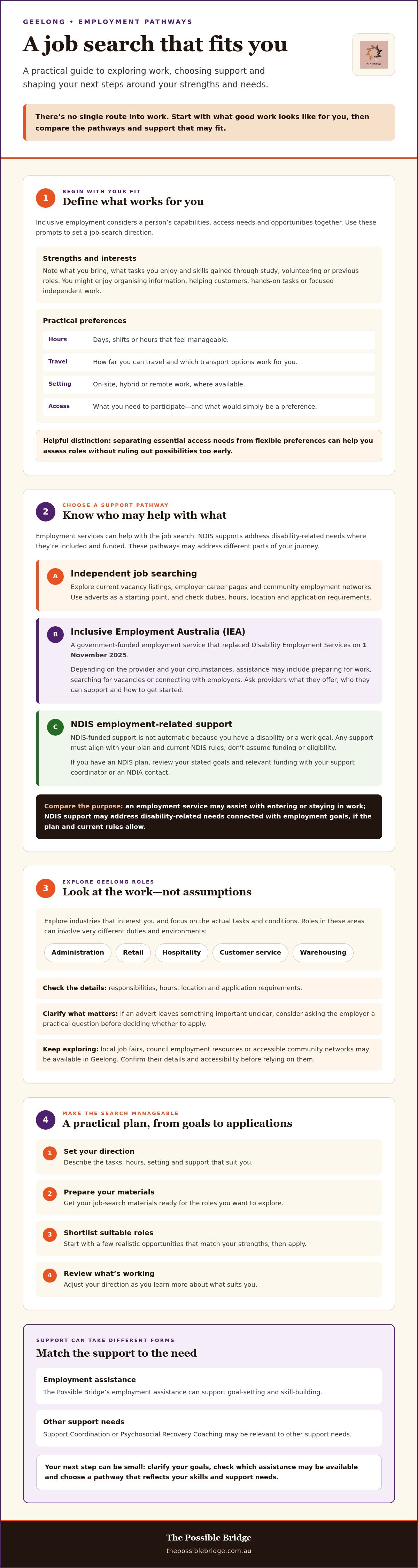
A practical job-search plan for Geelong: from goals to applications
A clear process can make finding a job with a disability in Geelong feel more manageable. Treat it as a series of small steps, not a test of how many applications you can send. Start with a short list of roles that match your skills, preferences and access needs, then adjust your plan as you learn.
- Clarify your goals. Note the tasks, hours, setting and travel arrangements you’re looking for. Be clear about essential needs while leaving room to consider roles that may not match every preference.
- Prepare your application materials. Tailor your résumé and application to each role’s key requirements. Highlight relevant strengths and experience from paid work, study, volunteering or other activities.
- Identify opportunities. Check current vacancies and employer career pages in Geelong. Choose a small number of realistic roles to start with rather than pursuing every listing.
- Apply and plan for access. Follow the application instructions and consider whether an adjustment would help with an interview, communication, hours or workplace tasks.
- Review and refine. Track applications and responses, then use what you learn to shape your next step.
Prepare applications and plan for workplace adjustments
Match your application to the work itself. If a role asks for customer communication, for example, describe relevant experience that shows how you communicate effectively. You can also consider adjustments that could help you participate, such as a different interview format or clearer written instructions. What you share about disability is personal. You can focus on information relevant to an adjustment or safe work, and decide what feels appropriate for the situation.
For current information about workplace adjustments and the right contact pathway, check JobAccess. Confirm which advice or assistance applies to your circumstances.
Build momentum with manageable follow-up steps
Keep a simple log with the role, employer, application date, response and any follow-up date. After an interview, note what went well and what you might prepare differently next time. These notes can make each application a useful learning experience, whether or not it leads to an offer.
Review your plan with a trusted supporter or employment professional if that would help you decide what to try next. If you’d like to explore employment assistance focused on your goals and skills, explore employment support with The Possible Bridge. Support can help you work towards your goals, but it can’t guarantee a job.
How The Possible Bridge can support employment goals in Geelong
Finding a job with a disability in Geelong can involve more than identifying vacancies. The Possible Bridge provides employment assistance to help people work towards their goals, build skills and connect with community resources. Its approach is collaborative: your interests and priorities guide the conversation, and support can be considered in light of your circumstances and NDIS plan.
The Possible Bridge also provides services across Melbourne, Ballarat and Bendigo. Support Coordination or Psychosocial Recovery Coaching may be relevant if either matches your broader support needs. Support Coordination can help NDIS participants understand and connect with relevant services. Recovery Coaching may suit people seeking support with psychosocial recovery. These are distinct supports, so discuss what you’re looking for and whether each is appropriate to your situation. Confirm local availability and service scope directly.
What a first conversation about work goals could cover
A useful starting conversation is about what matters to you, not just the job title you have in mind. You might discuss your interests and strengths, the kind of work you’d like to explore, what feels challenging and what support you want to consider. You can also talk through practical preferences such as hours, travel and workplace setting.
If you have an NDIS plan, bring relevant information about your goals and funding, along with questions about what employment-related support may fit. Funding or approval isn’t automatic, so check your plan and current rules with the appropriate contact. You remain central to decisions about your goals and next steps.
Take the next step towards work that fits
Before deciding, ask whether employment assistance is currently available in your part of Geelong and what the service covers. You could also ask how support is delivered, how goals are agreed, how progress is reviewed and what happens if your priorities change. Clear answers can help you judge whether the approach is practical and aligned with what you want from work.
Share your location, current plan details and the kind of help you’re seeking so the conversation can focus on your circumstances. The Possible Bridge works across Victoria, including Geelong, but confirm current local availability and service scope directly. Employment assistance can support goal-setting and skill-building, but it can’t guarantee a job, a particular outcome or NDIS funding.
If you’d like to explore whether the support may suit your goals, talk with The Possible Bridge about your employment goals.
Take your next step towards work that fits
Finding a job with a disability in Geelong starts with your goals, strengths and access needs, not a one-size-fits-all route. A manageable search can begin with a few suitable roles, tailored applications and a simple way to track progress. You can compare independent searching, employment services and NDIS-related support, then check which options fit your circumstances and plan.
The Possible Bridge provides employment assistance to help people work towards their goals, build skills and connect with community resources. It also offers Support Coordination and Psychosocial Recovery Coaching, with services across Victoria, including Geelong, Melbourne, Ballarat and Bendigo. Availability, service scope and NDIS funding depend on individual circumstances, so discuss what you’re looking for and confirm the details.
Share your employment goals, location, current plan information and the support you hope to explore. Talk with The Possible Bridge about your employment goals and consider whether its supports suit your next step. You don’t need every answer before you begin. A clear first step can help you build momentum towards work that reflects your skills and preferences.
Frequently Asked Questions
Can the NDIS help me find a job?
The NDIS may fund disability-related supports connected with your employment goals if you’re eligible and the support is included and funded in your plan. It doesn’t guarantee a job or automatically fund every employment service. Check your plan and current NDIA guidance, then ask suitable local providers what they offer and whether their support may fit your circumstances. A support coordinator or NDIA contact can help you clarify what to check.
How can I find a job with a disability in Geelong?
To find a job with a disability in Geelong, begin by noting your strengths, interests, preferred hours and access needs. Search current vacancies and employer career pages, then shortlist roles that look like a practical fit. Employment services or NDIS-related supports may also be options, depending on your circumstances and plan. Confirm local availability and entry requirements directly. One manageable first step could be updating your résumé or contacting a provider to ask about its service.
Do I have to tell an employer about my disability when applying for a job?
Disclosure is a personal decision, and there isn’t one approach that suits every jobseeker. Your decision may depend on the role, any relevant safety requirements and whether you want an adjustment for an interview or the work itself. Consider what information an employer needs to understand and arrange the adjustment you’re seeking. If you’re unsure, seek current guidance from an appropriate Australian workplace resource. This general information isn’t individual legal advice.
What is the difference between disability employment services and NDIS employment support?
Employment services may help people prepare for work, search for roles or connect with employers, depending on current program rules and personal circumstances. In Australia, Disability Employment Services was replaced by Inclusive Employment Australia on 1 November 2025. NDIS supports relate to disability-related needs and depend on eligibility, plan funding and current rules. The pathways can serve different purposes. Check each provider’s service scope, referral process and availability, as well as what your plan may fund.
Can I work while receiving NDIS support?
Having a job doesn’t, by itself, determine whether you can access particular NDIS supports. Access and funding depend on your individual circumstances, eligibility and current NDIS rules. If work changes your goals or support needs, discuss this with the NDIA or a suitable support coordinator. They can help you identify what information to check, but only a review of your relevant details can clarify how your plan applies. Don’t assume that employment automatically changes or ends a support.
Where can I get help with workplace adjustments in Geelong?
Start by identifying the adjustment you’re considering, such as changes to communication, equipment, tasks or interview arrangements. JobAccess provides information about workplace adjustments, so check its current advice and contact pathways for your situation. You can also ask an employer, employment service or relevant support provider about practical options in Geelong and what information may be needed. The Possible Bridge works across Melbourne, Ballarat, Geelong and Bendigo; confirm current local availability and service scope directly.


