

The ndis service provider with the longest list of supports isn’t necessarily the right fit. Focus instead on whether the provider offers the support you need, communicates clearly and works in a way that suits your goals, preferences and NDIS plan.
It’s understandable to feel unsure when providers differ in registration, communication and knowledge of local options. Registration is one factor to check, but what it means for your plan depends on the support you’re considering. You deserve clear answers and time to decide, without pressure.
This guide offers a practical framework for comparing NDIS service providers in Victoria. Learn how to check whether a provider’s services match your goals, what to ask about experience and communication, and how local knowledge may help you connect with community opportunities. We’ll also explain how support coordination, employment assistance and psychosocial recovery coaching differ, so you can consider which pathway fits your priorities. Asking clear questions can help you take an informed next step towards support that feels right for you.
Key Takeaways
- Compare an ndis service provider by how well its support, experience and communication match your goals, not by service labels alone.
- Ask for relevant examples and clear information about availability and fees before deciding.
- Consider which pathway fits your priorities: support coordination, psychosocial recovery coaching and employment assistance have different purposes.
- Build a shortlist by defining your needs, checking local options, asking questions and confirming current availability in your area.
- Check whether The Possible Bridge’s services align with your goals in Melbourne, Ballarat, Geelong, Bendigo and surrounding regional areas.
What should you expect from an NDIS service provider?
An NDIS service provider is a person or organisation that delivers supports funded through a participant’s plan. Look beyond the service name: check that the provider offers the support you’re seeking, communicates in a way that works for you, can confirm current availability and respects your choices.
For example, if building confidence to pursue work is one of your goals, ask what employment assistance involves and how the provider would work with you towards it. Broad phrases such as “personalised support” don’t explain what you’ll actually receive. Ask what the support includes, how you’ll be involved and how you can review whether it continues to meet your needs.
Registration requirements can depend on the support being delivered and how your plan is managed. Don’t assume the same rules apply to every provider or service. Check current guidance through the official NDIS website, and confirm a provider’s registration status and relevant registration groups where applicable. For background on the scheme’s history and governance, see this overview of the National Disability Insurance Scheme (NDIS).
How do NDIS providers differ from the NDIA and NDIS Commission?
Providers deliver supports. The National Disability Insurance Agency (NDIA) administers the scheme, including participant plans and funding. The NDIS Quality and Safeguards Commission regulates providers and works to uphold safety and quality. It isn’t a provider-matching service, so you’ll need to assess whether a provider suits your goals. Use official NDIS and Commission information to check current rules and provider details.
What does a good provider relationship look like?
A constructive provider relationship makes room for your priorities. You should be able to discuss goals, ask questions and understand what has been agreed without feeling rushed. Notice whether the provider listens, explains options clearly and checks that its communication works for you. These are practical signs to discuss, not promises of a particular outcome.
Agreed goals can guide regular conversations about your support. You might review what’s working, mention changes in your circumstances and decide whether the approach still fits. A good provider relationship should respect your right to make choices and speak up if something doesn’t feel right. Compare what the provider will actually deliver, not just its labels or promotional claims.
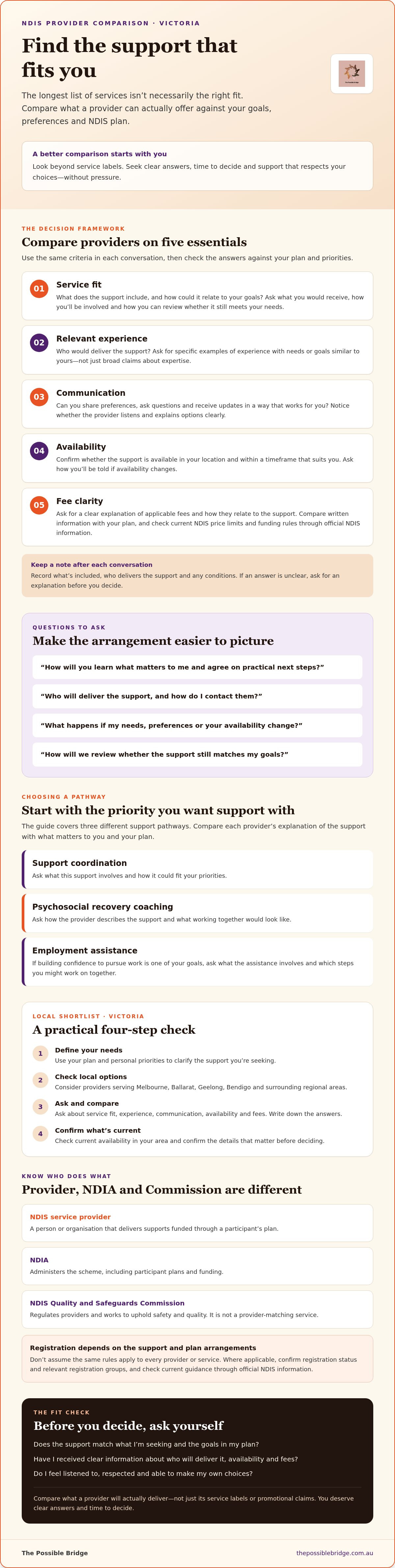
How to compare NDIS service providers: five decision criteria
A useful comparison goes beyond polished descriptions. Take your plan and personal priorities into each conversation, then compare what providers can explain about the support they’ll deliver. The NDIA’s guidance on how to find and choose a provider is a helpful starting point. These five criteria can help you assess how each option fits your circumstances.
- Service fit: Ask what the support includes and how it relates to your goals. If you want to explore employment, ask what employment assistance could involve and which steps you might work on together.
- Relevant experience: Ask who would deliver the support and what experience they have with needs or goals similar to yours. Look for specific examples rather than broad claims about expertise.
- Communication: Discuss how you’ll share preferences, ask questions and receive updates. Check that the provider can communicate in a way that works for you.
- Availability: Confirm whether the provider can offer the support in your location and within a timeframe that suits you. Ask how they’ll tell you if availability changes.
- Fee clarity: Ask for a clear explanation of applicable fees and how they relate to the support. Compare written information with your plan, and check current NDIS price limits and funding rules through official NDIS information.
Make a note after each conversation. Written responses can help you compare what’s included, who delivers the support and any conditions. Check those details against your plan and priorities. If an answer is unclear, ask the provider to explain before you decide.
Which questions reveal whether a provider is the right fit?
Try asking: “How will you learn what matters to me and agree on practical next steps?” “Who will deliver the support, and how do I contact them?” “What happens if my needs, preferences or your availability change?” Clear answers can help you picture how the arrangement may work day to day. You could also ask how you’ll review whether the support still matches your goals.
How can you check registration, safeguards and fees?
Check whether registration applies to the support and your plan arrangements, and confirm relevant details through official NDIS or Commission information. Ask how to give feedback, raise a concern or make a complaint, and what happens next. For fees, request current written information and compare it with official NDIS guidance rather than relying on old examples or informal estimates.
If you’re considering support coordination, employment assistance or psychosocial recovery coaching, you can discuss whether these support options fit your goals with The Possible Bridge.
Which NDIS support service matches your goals?
Support coordination, psychosocial recovery coaching and employment assistance have different purposes. A provider offering more than one type of support won’t necessarily offer the right service, or combination of services, for you. Start with the goal you want to work towards. Then ask what each support involves and whether it’s included in your plan.
| Your goal | How support may help | Questions to ask |
|---|---|---|
| Understand and connect with supports | Support coordination may help you make sense of available supports and connect with services that relate to your plan and goals. | How would you learn about my current support network? What coordination would be useful for me? |
| Work towards psychosocial recovery goals | Psychosocial recovery coaching may support you to identify recovery goals and consider practical steps that reflect your choices. | How would we decide on steps together? How would the support respond if my priorities changed? |
| Explore work-related goals | Employment assistance may help you build skills and explore options connected with work. | How would the support relate to my employment goals? What skills or next steps could we focus on? |
These descriptions are a starting point, not a promise of a particular outcome. The right support depends on your circumstances, what’s funded in your plan and what you want to focus on. Check your plan and discuss suitability with the provider before making arrangements.
When might support coordination be relevant?
Support coordination may be worth discussing if you want help understanding how different supports connect with your goals, or if you work with several services and want to consider how they fit together. Talk about what you already manage independently, who is part of your support network and where you’d value assistance. A coordinator’s role is not the same as managing your plan funding.
When might recovery coaching or employment assistance be relevant?
Psychosocial recovery coaching may align with goals related to psychosocial recovery. Employment assistance may suit you if you want to build skills or explore work. You may have one priority or several, but these support types aren’t interchangeable. Ask the provider to explain the focus of each option, how you’ll stay involved in decisions and whether it suits your plan and circumstances.
The Possible Bridge offers support coordination, employment assistance and psychosocial recovery coaching. Consider each service on its own merits, and ask whether its purpose matches the goal you want to work towards.
How to shortlist a local NDIS provider in Victoria
A local match is about more than distance. A nearby provider may be convenient, but your priorities, communication preferences and the support they can currently deliver matter just as much. Use this four-step process to create a shortlist, then compare two or three options. Don’t assume proximity alone means better quality.
- Define your needs. Note the goals you want to work towards, the support you’re considering and what matters to you in a provider relationship.
- Identify options. Look for providers offering the relevant support, then check whether they currently serve your area. If you’re in Bendigo, you could also compare options in Melbourne, Ballarat or Geelong if their arrangements suit your circumstances.
- Ask practical questions. Confirm who would deliver the support, how you’ll communicate and how appointments or community-based support are arranged.
- Review the fit. Compare each provider’s answers with your plan, preferences and priorities. Ask how continuity would work if your needs or the provider’s availability changed.
What should you confirm about local availability?
Ask whether the provider currently supports participants in your area. Check how appointments, travel or community-based support are arranged, and whether any details could affect how the service works for you. Discuss the proposed contact and service schedule, including how changes are communicated. Don’t rely on a broad locations list alone. Confirm the arrangement for your circumstances.
What if you are still weighing up eligibility or support needs?
First, write down what you’d like support to help you work towards. For background on access requirements, consult official NDIS guidance alongside the guide titled NDIS Eligibility Explained: Complete 2026 Guide to Access Requirements. If you’re comparing options beyond Bendigo, NDIS Provider Geelong: How to Find Support That Fits Your Goals may offer useful local comparison context. Guides can help you prepare questions, but rely on official NDIS information for current eligibility rules and decisions.
Once you’ve clarified the support you want to explore, take a low-pressure next step: discuss local support options with The Possible Bridge. Its services include support coordination, employment assistance and psychosocial recovery coaching. Ask about current availability in Bendigo and whether a service fits your goals and plan.
Is The Possible Bridge the right NDIS service provider for you?
The Possible Bridge may suit you if you’re looking for support coordination, employment assistance or psychosocial recovery coaching that connects with your personal goals. Its services focus on skill development, independence and community connections. Each has a different purpose, so consider it against what you want to work towards rather than assuming the full range of services will suit your needs.
The Possible Bridge works across Melbourne, Ballarat, Geelong, Bendigo and surrounding regional areas. This gives you a starting point for a local conversation, not a guarantee that a particular service is currently available where you live. Confirm current availability and delivery arrangements directly, then compare them with your preferences and plan.
Which goals may align with The Possible Bridge's services?
Start by identifying the kind of progress you want to explore. Support coordination may be relevant if you want help connecting your goals with supports and community resources. Employment assistance may suit work-related goals, such as developing skills or exploring employment options. Psychosocial recovery coaching focuses on participant-led recovery goals and the steps you choose to take. Ask what each service involves and how you would shape the support together.
The right fit depends on your circumstances and plan. Discuss whether the support you’re considering aligns with your funded supports, and clarify what the provider can deliver before making arrangements.
It’s also useful to know that The Possible Bridge doesn’t provide NDIS plan management, clinical psychology or 24/7 crisis intervention. If you’re seeking one of those services, you’ll need to look for a provider that offers it.
What is a simple next step if the fit feels right?
Start with a straightforward conversation. Share your location, the goals you want to work towards and the support you’re considering. Ask whether that support is currently available where you live, who would deliver it, how communication works and whether the proposed arrangement fits your plan. You don’t need to have every detail settled before asking questions.
When comparing an ndis service provider, look for clear answers and room to make your own decision. If The Possible Bridge’s services sound relevant, contact the team to discuss support fit, current availability and applicable plan arrangements. A conversation can help you decide whether to take another step, at your own pace.
Take your next step towards support that fits
Choosing an ndis service provider is about more than finding a service nearby. Compare how the support aligns with your goals, how clearly the provider communicates and whether the arrangements suit your plan and preferences. Support coordination, employment assistance and psychosocial recovery coaching each have a distinct purpose, so focus on the pathway that fits what you want to work towards.
The Possible Bridge provides these three supports across Melbourne, Ballarat, Geelong, Bendigo and surrounding regional areas. Confirm current availability in your location, then ask whether the service you’re considering matches your goals and plan. A conversation can help you understand your options without committing before you’re ready.
Explore The Possible Bridge’s NDIS support services and discuss which support may suit your priorities. You can take things one step at a time, with your goals guiding the way.
Frequently Asked Questions
How do I choose an NDIS service provider?
Start with the participant’s goals and the specific support they need. Compare each ndis service provider’s relevant experience, communication, availability, safeguards and fee information. Ask who will deliver the support, how it will work in practice, and how changes or concerns are handled. Check registration where relevant to the support and plan arrangements, and confirm current rules through official NDIS sources. The right fit is the provider whose approach works for the participant.
Do NDIS providers have to be registered?
Not every provider or support arrangement has the same registration requirements. Whether registration is needed can depend on the support and the participant’s plan-management arrangements, and rules may change. Check current information from the NDIA, and verify a provider’s registration details where relevant. Registration is one part of your decision, alongside service fit, communication, safeguards and the participant’s preferences. If you’re unsure, seek guidance through official NDIS channels.
Can I change my NDIS service provider?
You can explore other providers, but first check your service agreement, any notice arrangements and what’s needed to maintain continuity of support. If you decide to change, consider planning the transition with relevant supports so important services aren’t unexpectedly interrupted. The steps depend on your circumstances and agreements, so don’t assume one process applies to everyone. Check current NDIS guidance or seek appropriate advice before making arrangements.
What is the difference between support coordination and psychosocial recovery coaching?
They’re distinct supports with different purposes, and the right option depends on your goals, plan and circumstances. Support coordination can help you connect with supports relevant to your goals. Psychosocial recovery coaching focuses on psychosocial recovery goals and participant-led steps towards them. Ask providers to explain what each service includes and how it could relate to your priorities. Check your plan to confirm what’s funded before deciding which support to explore.
Can I use more than one NDIS service provider?
You may be able to work with different providers for different supports, depending on your plan and circumstances. Check that each service has a clear purpose, that you understand the arrangements and that communication between providers feels manageable. Ask how a provider would coordinate with other supports and what information they may need to share. Your preferences and control should remain central as you decide which providers, if any, are right for you.
How do I check whether an NDIS provider is right for my location?
Ask whether the provider currently delivers the specific support in your area. If you’re in Melbourne, Ballarat, Geelong or Bendigo, confirm availability directly, as coverage can vary by service. Check how appointments or other delivery arrangements work, and whether the proposed schedule suits you. Compare local access alongside experience, communication and service fit. Being nearby can be useful, but proximity alone doesn’t show whether a provider is the right match.
Does The Possible Bridge provide NDIS plan management or crisis support?
No. The Possible Bridge’s services are support coordination, employment assistance and psychosocial recovery coaching. It doesn’t provide NDIS plan management, clinical psychology or 24/7 crisis intervention. If you need one of those services, contact an appropriate provider or official support channel. If you’re exploring support coordination, employment or recovery goals, ask The Possible Bridge whether one of its services may fit your priorities and confirm current availability in your area.


